Description
What the AK9234BS is and where it fits
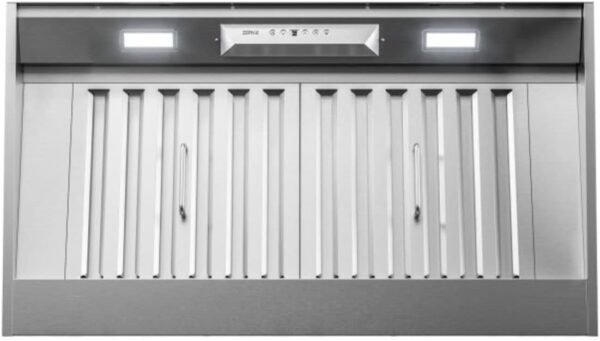
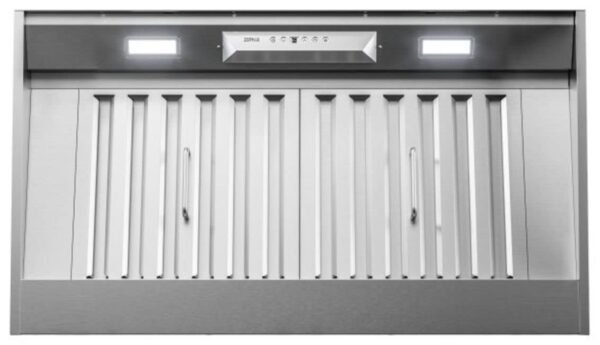
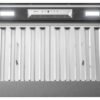
An insert is not a finished range hood. It is a liner containing the blower, filters, lights and controls, designed to be fitted inside a hood enclosure that somebody else builds: a plaster chimney, a timber canopy, a run of cabinetry. That distinction is the most important thing to understand before ordering, because the insert on its own is not something that can be hung on a wall and used. Zephyr’s Monsoon I is 34 inches wide, 19 and a quarter inches deep and 12 inches high, weighing 53 pounds, in stainless steel, with a one piece liner construction that has no seams for grease to collect in.
Living with it day to day
The published noise figure here is given in sones rather than decibels, at 6 sones, and sones are the honest unit for ventilation because they scale the way human loudness perception does: doubling the sone figure doubles the perceived loudness, which decibels do not. Six sones at full speed is audible but ordinary for a 600 cubic foot per minute hood, and six speed control means the lower settings will be considerably quieter. Zephyr’s Airflow Control Technology is the name for that speed management.
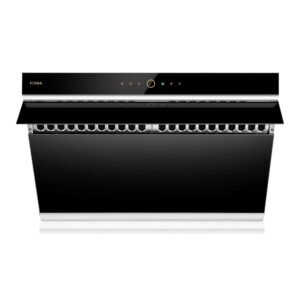
Dual level LumiLight LED lighting is fitted, with 6 watt bulbs, and the lighting on an insert matters more than on a visible hood, because an insert sits deep inside an enclosure and the cooking surface below it gets no light from anywhere else. The wireless remote is described as ADA compliant, and its practical purpose is not accessibility alone: the controls on an insert sit high above the cooktop, and reaching over hot pans to change fan speed is exactly what a remote avoids. A touch panel is also fitted on the unit itself. The alternative finished hood format is the FOTILE JQG7505, which arrives ready to mount.
Controls and connected features
There is no WiFi, no app and no connected platform, which for a range hood is the correct decision. Control is a touch panel on the liner plus a wireless remote, and six electronic speeds. Nothing needs pairing beyond the remote itself, there is no account and no firmware, so the hood will work the same way for its whole life. The one thing worth planning for is the remote: a wireless remote is a small object that gets lost, and it is the primary control on an installation where the panel is out of comfortable reach, so a wall cradle is worth fitting.
What a connected hood might otherwise offer, such as linking to a cooktop or running automatically, is absent here and is not much missed. A hood is operated by the person standing in front of it, and the useful automation on any hood is a delayed shut off rather than a phone app.
Running cost and upkeep
Zephyr publishes the electrical supply as 120 volts, which is an ordinary North American circuit, though no amperage is given, so the installation manual should be consulted for the branch circuit. The ducting specification is also published and this is the useful part: an 8 inch round duct with either horizontal or vertical discharge. Eight inches is a large duct and it is what a 600 cubic foot per minute blower needs to perform as rated; running it into a smaller existing duct will cost airflow and add noise. Mounting height above the cooktop is specified at 24 to 30 inches, which is exactly the sort of installation figure most hood listings omit and which decides both capture performance and whether the cook keeps hitting their head.
Filtration is where this listing contradicts itself. Zephyr’s description specifies professional baffle filters and explains that they can be cleaned by soaking overnight in a tank with a metal safe cleaner, while the specification table records the filter type as mesh. Those are different components with different cleaning routines and different grease capture behavior, so the filter type should be confirmed before purchase. The warranty is stated as one year labor and three years parts, which is better than the one year total that several appliances in this catalog carry. There are no consumable filters on a ducted hood, so ongoing cost is the LED bulbs and electricity. It is also worth noting that a 600 cubic foot per minute hood sits above the threshold at which residential codes commonly require makeup air, so that question belongs with a local building authority before installation. Cooktops that would sit beneath include the LG LCE3010SB and the Frigidaire FFEC3025UB, an over the range microwave such as the GE JVM3160DFCC is the low cost alternative to a hood entirely, and the category sits under range hoods.
Highlights
- Duct size, discharge direction, voltage and mounting height are all published.
- Noise is given in sones, which is the honest unit for ventilation loudness.
- Six speeds with Zephyr’s airflow control rather than a three position switch.
- One piece liner construction with no seams for grease to collect in.
- Dual level LED lighting, which matters because an insert sits deep in an enclosure.
- Three year parts warranty, better than most appliances in this catalog.
Things To Consider
- This is an insert, so a custom hood enclosure has to be built or bought separately.
- The description specifies baffle filters while the specification table says mesh.
- The description quotes the 600 CFM blower for 30 and 36 inch models, though this is the 34 inch unit.
- An 8 inch round duct is large, and reusing a smaller existing duct will cost airflow.
- A hood at this airflow commonly triggers a makeup air requirement in residential codes.
- The model appears as AK9234B in the title and AK9234BS in the specification.
Who it is not for
Anyone expecting a hood they can hang on a wall should buy a finished canopy instead, because an insert without an enclosure is not a usable appliance. Kitchens that cannot duct to outside cannot use this at all. Households replacing an existing hood with a smaller duct should either upgrade the duct or accept reduced airflow and more noise. And anyone in a tightly sealed house should settle the makeup air question with a local inspector before the cabinetry is built around it.