


Description
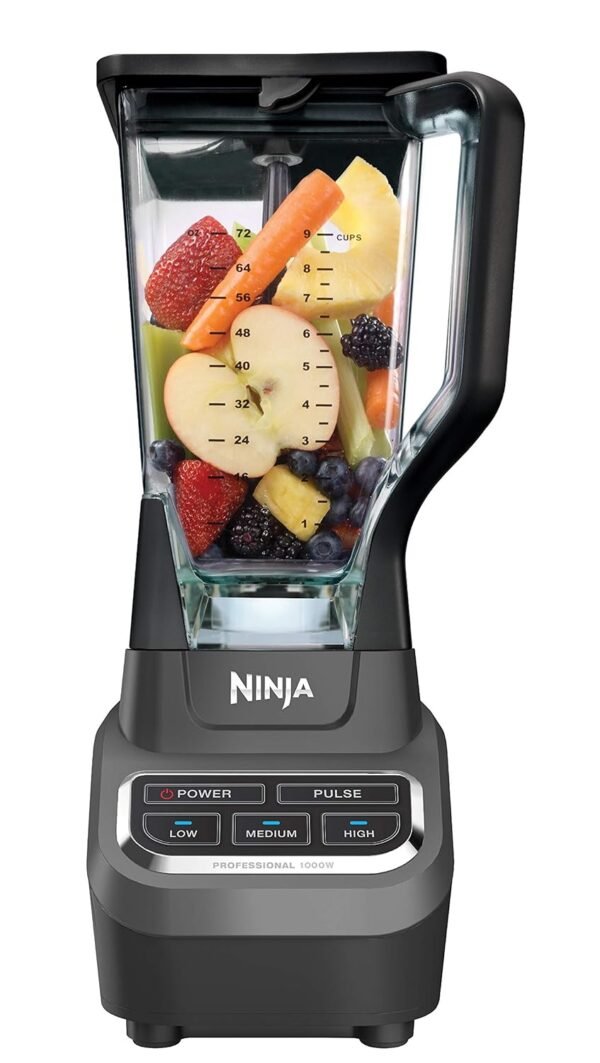
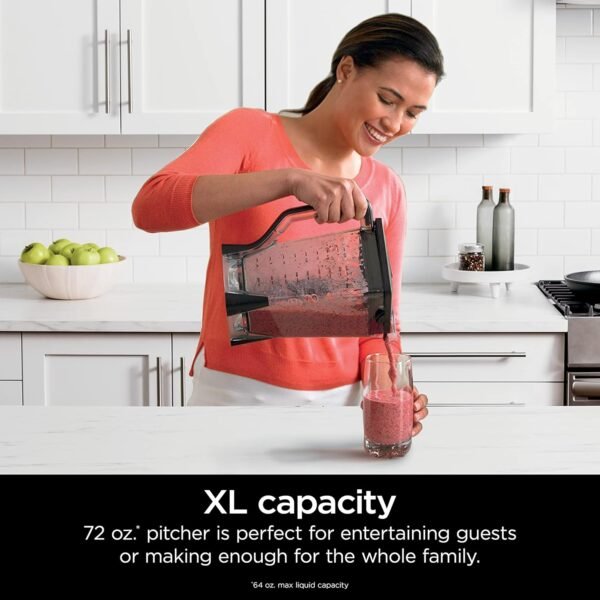
The Ninja BL610 is the fully documented listing for this blender in this catalog, and it is the one to read if you want specifications. Ninja records a 72 fluid ounce capacity, dimensions of 10.71 inches deep by 8.27 wide by 15.94 tall, a listed weight of 7.1 pounds, corded electric power, four speeds, 120 volts, BPA free materials, stainless steel blades, a limited warranty, SharkNinja as manufacturer, a China country of origin, model number BL610 and first availability in September 2014. Included are a recipe guide, the 72 ounce Total Crushing pitcher with lid, and a motor base described as 1000 watts. Note that this catalog also carries a duplicate listing for the same model with no specification data at all.
What it is and where it fits in a home
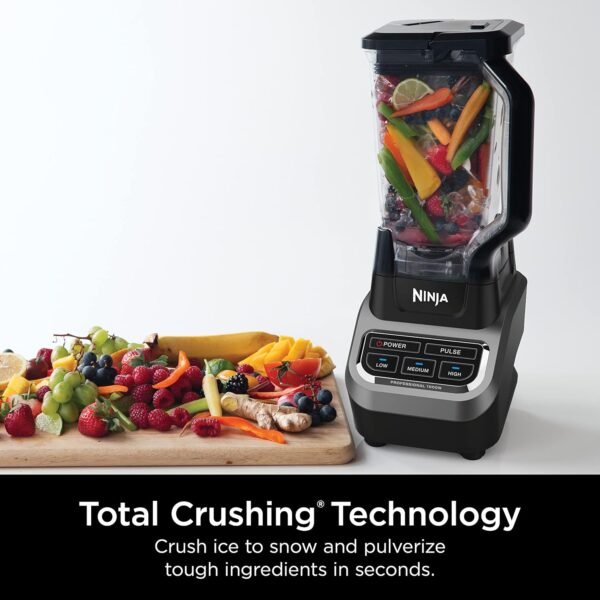
This is a workhorse jug blender rather than a precision one. It is built to break ice and frozen fruit into drinkable texture at speed, and everything about its design points that way. In a household it lives on the counter and gets used for smoothies, frozen drinks, milkshakes and rough purees.
At 15.94 inches tall on its base, it will not fit under a standard wall cabinet with about 15 inches of clearance, so it needs an open corner or has to be moved for each use. The 10.71 inch depth is more forgiving. At 7.1 pounds the base is light for a machine of this power, which is worth knowing: heavier bases stay put better under load, and a light base with a full pitcher of ice will walk on a smooth counter if it is not held.
Living with it day to day
72 ounces is a real batch: four to six servings at once. That is the argument for a jug blender over a personal one such as the Ninja QB3001SS, and it is also the daily annoyance, because a single smoothie means washing a large pitcher.
Four speeds is fewer than the ten offered by machines such as the Vitamix VM0197 Explorian, and it tells you what kind of tool this is. A crushing blender is used at full power in short bursts with the pulse function, not modulated gradually through a range. Anyone who wants gradual control for emulsions and slow starts is buying the wrong category.
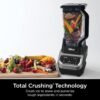
The Total Crushing blade assembly is a vertical column of blades rather than a single blade at the base. It reaches ice throughout the pitcher rather than relying on a vortex to bring it down. The trade is that it is a loose, sharp assembly that lifts out for washing, and every household with one develops a careful routine around it.
Noise is not published and it is a real factor. High powered jug blenders are loud enough to wake a house, and this one has no sound enclosure. The Blendtec Connoisseur 825 in this catalog is the model that addresses noise explicitly, and it does so at an entirely different level of machine.
Upkeep is simple: the pitcher and blades are dishwasher safe, and the base wipes down.
Controls and what works without an app
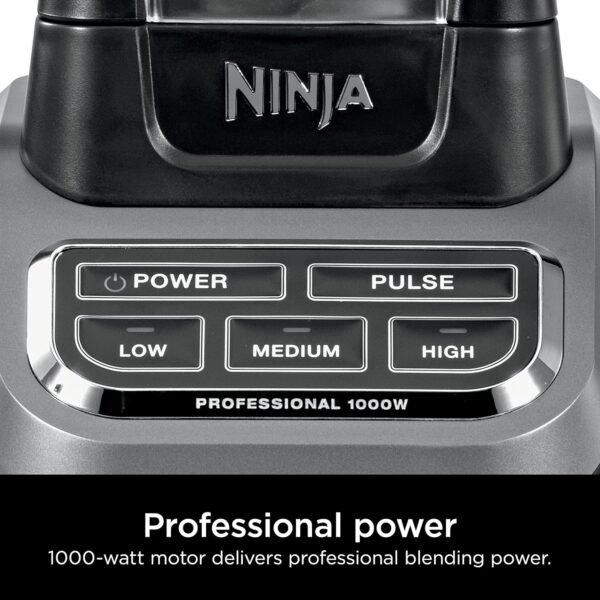
There is nothing connected and nothing should be. No app, no Wi-Fi, no display, no account. Four speeds and a pulse function on the base, and that is the whole interface.
This is the right answer for the tool. A blender runs for thirty seconds at a time at full power, and there is nothing an app can usefully add to that, which is why the connected blenders in this catalog such as the Vitamix A3300 use their electronics for container recognition and timing rather than for remote control. Nothing on the BL610 can stop working because of a software decision, and in ten years the four speed switch will do exactly what it does now.
Running cost and upkeep
No consumables at all. No filters, no descaling, no water connection, nothing on a schedule. The electricity cost of a blender is negligible because it runs in bursts.
The parts that wear are the blade assembly, which eventually dulls, the pitcher gasket, which is where leaks start, and the drive coupling between base and pitcher, which is the plastic part that usually decides when a blender’s life ends. Because the BL610 has been sold since 2014, all three are widely available, which is a genuine ownership advantage over a newer model with a smaller parts network.
Electrically, Ninja publishes 120 volts, which is more than many listings in this catalog manage. The 1000 watt figure is worth reading carefully: it appears in the style field as Generation 2, 1000 Watts and in the included components list as a 1000 watt motor base, rather than in a wattage specification field. That reads as a marketing designation as much as a measured input rating. No amperage is published, and the rating plate on the base is the source if the circuit matters.
Highlights
- 72 ounce batch capacity, which is what a jug blender is for.
- Voltage is published, unlike many small appliance listings here.
- Stacked crushing blades built specifically for ice and frozen fruit.
- Dishwasher safe BPA free pitcher and blade assembly.
- Sold since 2014, so gaskets, pitchers and couplings are easy to find.
Things To Consider
- The 1000 watt figure appears in the style name rather than as a measured wattage rating.
- At 15.94 inches tall it will not fit under a standard wall cabinet.
- A 7.1 pound base is light, and a full pitcher of ice can move it on a smooth counter.
- Four speeds only, so it is a burst tool rather than a machine for gradual control.
- No noise figure is published, and there is no sound enclosure.
Who it is not for
Anyone blending single servings should look at the personal size blender category instead of washing a 72 ounce pitcher daily. Anyone who wants nut butters, hot soup or very fine textures needs a high torque machine with a tamper, not a crushing blender. Anyone blending early in a shared home should take the noise seriously. And anyone who wants precise speed control across a wide range will find four speeds limiting compared with the machines in the countertop blender category that offer ten.