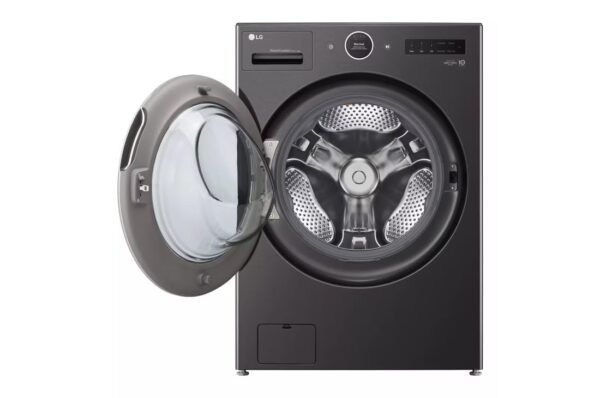
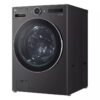
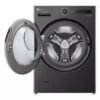
Description
What the WM6998HBA is and where it fits
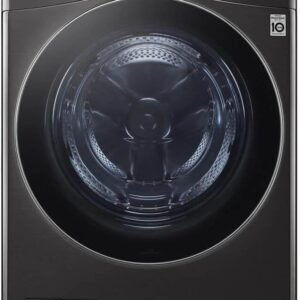
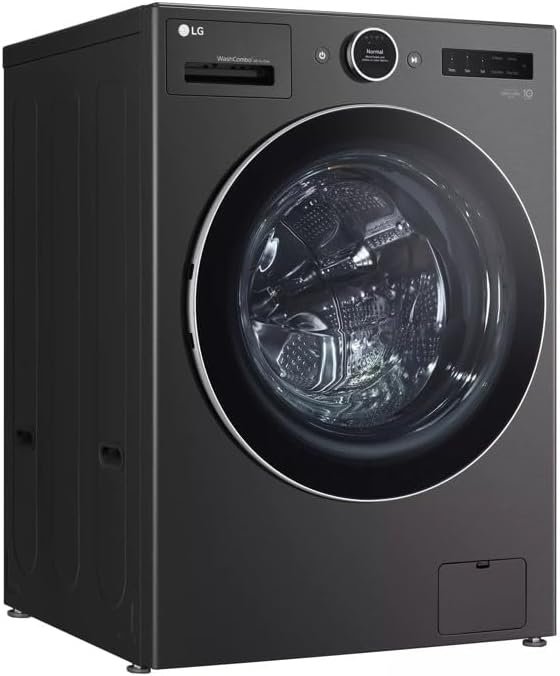
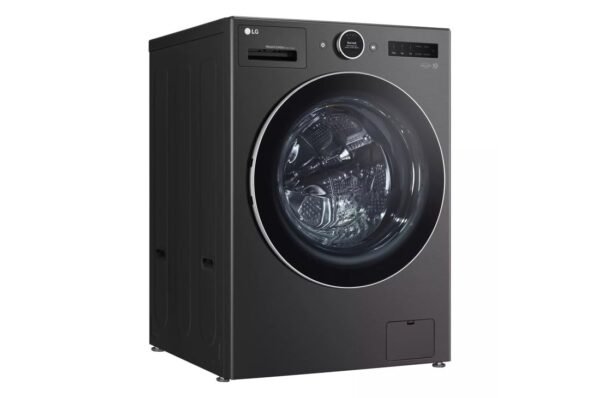
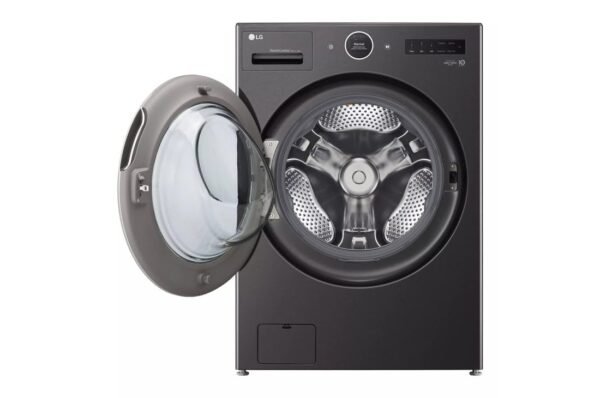
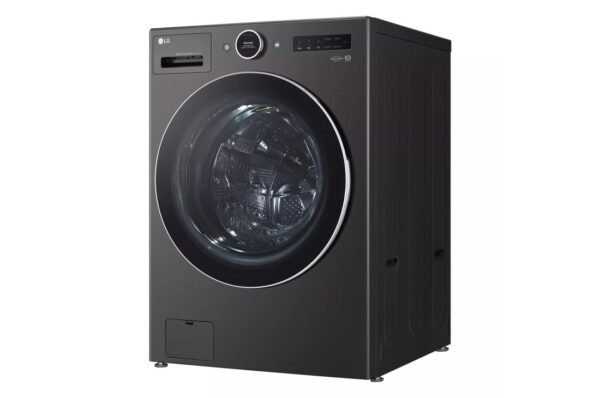
LG’s WashCombo does the whole laundry job in one drum: wash, then dry, without anyone moving anything. What makes this particular machine interesting is how it dries. A conventional dryer heats air with an element or a gas burner and throws that heat outside through a duct. A heat pump dryer recirculates air, condensing moisture out of it and reusing the heat, which means no duct at all and considerably less energy for the same job. LG lists the capacity at 5.0 cubic feet, the weight at 260.1 pounds, and the finish in black steel or graphite steel. Where this belongs is a home with no route for a dryer vent: an interior apartment, a condominium, a converted closet.
Living with it day to day
Heat pump drying changes the daily rhythm in two ways that deserve honest treatment. It is gentler, because the air is warm rather than hot, so clothes come out with less thermal stress and shrinkage. It is also slower, because lower temperature drying takes longer, and a combination unit that washes and then dries in sequence produces a total cycle time far longer than a wash followed by a separate vented dryer. For a household that runs one or two loads a day and does not need laundry finished within the hour, that is a fair trade. For a household that does five loads on a Saturday, it is not.
The other structural characteristic of a combo is that the drying capacity is smaller than the washing capacity, because drying needs air space. LG does not publish a separate drying capacity in this listing, so the practical question of whether a full 5.0 cubic foot wash load can be dried in one go is unanswered here and should be checked in the manual. LG publishes no decibel rating either, although a direct drive motor removes the belt that is a common noise source, and a heat pump compressor makes a different sound from a heating element, which is to say it is audible in a way an element is not. The other combination units in this catalog take different approaches: the Samsung WD53DBA900HZ and the GE PFQ97HSPVDS are the direct comparisons.
Controls and connected features
The control type is listed as touch, and LG’s combination machines sit on the ThinQ platform, though this listing does not describe the app functions or name them. On a machine that runs very long cycles, remote notification is genuinely more useful than it is on a quick washer: knowing from another room that a three hour combined cycle has finished saves checking. What the listing does not answer is what the panel offers with no network, and buyers should establish that before assuming. The washing and drying themselves are executed by the machine’s own control board and do not require a connection, which is the general rule for laundry appliances.
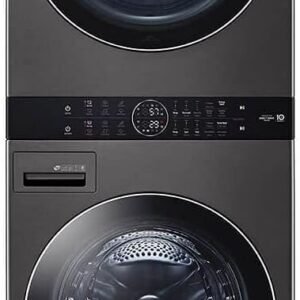
One cycle option is named in the specification data, Speed Wash, which on a combination machine is a shorter wash rather than a shorter dry, and the drying stage is where the time actually goes. Anyone choosing this format for its convenience should be clear that the convenience is not having to transfer laundry, not finishing faster, which is the opposite of what a stacked pair such as the LG WKEX200HWA WashTower offers.
Running cost and upkeep
The electrical data in this listing must be treated with care. The voltage field reads 2.2E plus 2 volts AC, which is 220 volts written in scientific notation, and 220 volts is not how a standard North American domestic outlet is described. No amperage is published at all. Combination machines exist in both ordinary outlet and dedicated circuit forms, and a heat pump dryer draws far less power than an element dryer, so this is precisely the appliance where the answer cannot be guessed from the category. The electrical requirement must be taken from LG’s installation manual and matched against what is present in the laundry space, with an electrician involved if they do not match. The stated dimensions of 27 inches deep, 39 wide and 57 high also do not describe a 27 inch wide front loading laundry appliance in that orientation, and look like scrambled or carton figures.
Ventless is the operating advantage and it comes with its own requirements. No duct is needed, but the water condensed out of the laundry has to go somewhere, which on a machine like this means the drain, so a drain connection is still required. A heat pump dryer also has a condenser or filter arrangement that collects lint, and that needs cleaning on a schedule, which is a different chore from emptying a lint screen and is the maintenance item most often neglected on heat pump machines. Blocked, it slows drying and raises energy use. Otherwise upkeep is standard front loader practice: leave the door ajar, wipe the gasket, run a tub clean cycle. LG publishes no annual energy figure in this listing, so the efficiency advantage of heat pump drying cannot be quantified here even though it is real. Other machines in the category are covered under washers, including standalone options such as the LG WM4000HWA.
Highlights
- Ventless heat pump drying, so no duct to an exterior wall is required.
- Washes and dries in one drum, with no transfer of wet laundry between machines.
- 5.0 cubic feet of wash capacity, which is large for a combination unit.
- Heat pump drying runs at lower temperatures, which is gentler on fabric.
- Direct drive motor removes the drive belt as a wear and noise item.
- Suits apartments and interior rooms where a vented dryer is simply not possible.
Things To Consider
- The voltage field reads 220 volts in scientific notation, which is not a standard North American outlet description.
- No amperage is published, so the circuit requirement cannot be established from the listing.
- Stated dimensions of 27 by 39 by 57 inches do not describe this appliance in any orientation.
- Heat pump drying is slower, and a combined wash and dry cycle takes a long time.
- No separate drying capacity is published, so a full wash load may need splitting to dry.
- The heat pump lint and condenser filter needs regular cleaning, which is easy to forget.
Who it is not for
A household doing high volumes of laundry should not buy any combination unit, because one drum doing two jobs in sequence is the slowest arrangement available. Anyone who has a vent route and space for a pair will get faster results and cheaper repairs from two machines. Buyers who need laundry finished quickly should note that heat pump drying trades speed for efficiency by design. And anyone specifying an installation from this listing needs to stop and read the manual, because the published voltage cannot be taken at face value and no amperage is given at all.