Description
A percolator does not work like anything else in this catalog. Water in the base is heated until it climbs a central tube, sprays over a basket of coarse grounds, drains back into the base and gets pumped up again. The same coffee is brewed repeatedly until the machine decides it is done. That produces a specific kind of cup, and it produces a specific set of habits.
What it is and where it fits
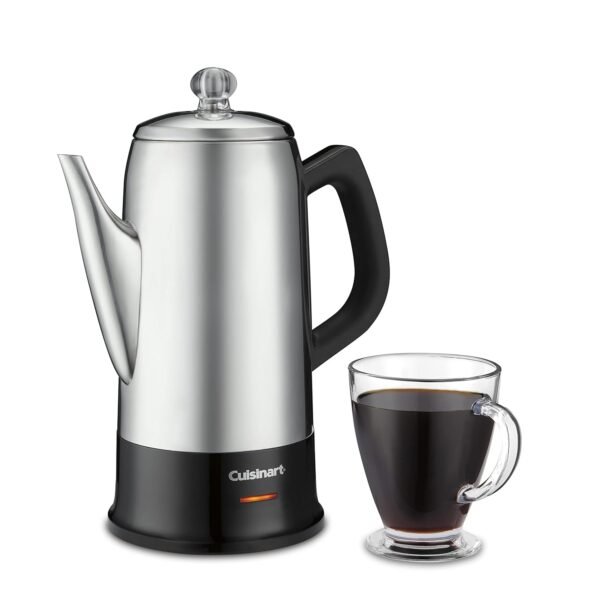
The Cuisinart PRC-12N is a stainless steel electric percolator listed at 6.25 inches deep by 9.25 inches wide by 12.25 inches high, weighing 3 pounds, with a capacity of 12 cups. Percolator cups are small, usually around five ounces, so twelve cups is roughly sixty ounces of coffee and it is a machine for serving a group rather than an individual.
Where it fits is a household or a gathering where a lot of coffee has to be made and kept hot, or a kitchen where somebody prefers percolator coffee to drip and is not going to be talked out of it. It is also the design that keeps working when a drip machine’s plastic parts fail, since the whole thing is metal and there is very little to go wrong.
Living with it day to day
Percolators announce themselves. The transparent knob on the lid exists so the brewing can be watched, and the audible perking is the traditional signal that it is working. That is charming in a kitchen and less charming in an open plan apartment at six in the morning, and no noise figure is published.
The real characteristic of percolator brewing is that it recirculates. Coffee that has already been extracted passes through the grounds again, which produces a strong, heavy cup and, if the machine is left running past the point it should stop, an over extracted and bitter one. Percolators of this type typically switch to a keep warm mode when brewing finishes, and the listing does not state the mechanism, so the manual is the authority on how it decides.
Two ergonomic details on the listing are worth naming because they address the real hazard. A percolator is a metal vessel full of boiling coffee, and the listing specifies a no drip spout and a handle with a knuckle guard. The knuckle guard is not decoration: it keeps the hand off a hot stainless body during a pour, and on a machine like this that is a genuine safety feature rather than a styling one.
Cleanup is straightforward. Grounds come out of the metal basket, and there is no paper and no carafe to break. Coffee oils do build up on the stem and inside the basket, and metal that is not properly cleaned makes later batches taste stale.
Controls and connected features
There is very little here, and that is the design. No display, no clock, no strength setting, no app, no Wi Fi and no account. Percolators of this type generally have a power indicator and a ready indicator and nothing else, and the listing records no interface information at all.
What controls the strength is the grind and the dose, plus how long the machine runs. Percolators need a coarse grind, coarser than drip, because a fine grind passes straight through a metal basket and produces sediment and bitterness. That is the single most useful thing to know before using one, and it is not on the listing anywhere.
Nothing here can lose software support, needs updating or requires a phone, which is the same argument that applies to the manual brewers in the percolators section and to stovetop style makers like the Imusa. An all metal appliance with a heating element and a thermostat is about as durable as kitchen equipment gets.
Running cost and upkeep
The listing publishes no voltage, no wattage and no amperage, which is a gap on an appliance that boils sixty ounces of water. A percolator element is not a small load, and the rating plate on the base is the only reliable source before it shares a circuit with a kettle or a toaster. It is a corded countertop appliance with no water line, no drain, no gas and no venting.
Running cost is effectively zero beyond the coffee. The basket is permanent metal, so there are no papers, no pods and no cartridges. Some people use paper percolator discs to reduce sediment, but nothing requires them.
Upkeep is descaling, which matters more on a percolator than on most machines because the water is boiled repeatedly and scale forms on the element and the stem. No interval is published. The parts that wear are the stem, the basket and the gasket under the lid, and stainless percolators are among the easiest appliances to keep running for a decade provided they are cleaned properly. The specification block on this listing is badly degraded, with the capacity and weight fields collapsed into entries where the label and the value are the same string, and no model number recorded at all.
Highlights
- All stainless construction with no plastic carafe to break or discolor.
- 12 cup capacity, so it serves a group from one brew.
- Knuckle guard on the handle, which addresses the real hazard of pouring from a hot metal vessel.
- No drip spout for pouring without a mess.
- Transparent lid knob so the brewing can be watched.
- Permanent metal basket with no papers, pods or cartridges to buy.
Things To Consider
- No voltage, wattage or amperage is published for an appliance that boils sixty ounces of water.
- Percolation recirculates the coffee, which over extracts if the machine runs too long.
- A coarse grind is required. Drip grind produces sediment and bitterness in a metal basket.
- Audible perking and a metal body make this a noisy machine, and no figure is published.
- Scale forms faster than in most machines because water is boiled repeatedly.
- The specification block is largely collapsed, with no model number recorded.
Who it is not for
Anyone who prefers a clean, light cup should not buy a percolator, because recirculated brewing produces the opposite of that and a paper filtered machine such as the Moccamaster KBT is the other end of the spectrum. Anyone brewing for one person will find twelve small cups excessive. Anyone who wants a timer, a strength control or any scheduling will find none of it, and the programmable machines in the coffee machines category cover that instead. And anyone who wants percolator coffee without the size should compare this against the Presto 02811 or a smaller stovetop style maker such as a plain drip machine if the goal is simply strong coffee with no fuss.