


Description
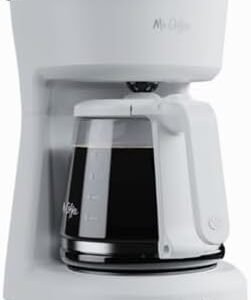
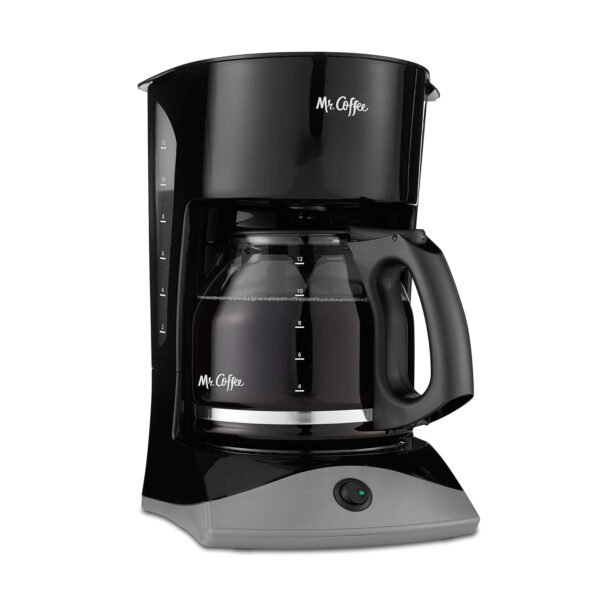
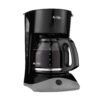
The SK13-RB is the black version of Mr. Coffee’s plainest 12 cup machine, and it is worth understanding as a deliberate set of omissions rather than a stripped down product. No clock, no timer, no strength control, no water filter and no thermal carafe. A switch, a carafe, a permanent filter and two conveniences that get used every day.
What it is and where it fits
This is a countertop drip maker for a household that wants a pot and nothing more. The listing gives the footprint as 11.76 inches deep by 12.3 inches wide by 13.8 inches high and the weight as 3.6 pounds, which is light enough to carry to the sink rather than carrying water to it. Under 14 inches tall clears most wall cabinets, though the lid still has to open.
The recommended uses field says traveling, which does not describe a 12 cup countertop machine with a glass carafe. That is an import error rather than a suggestion. What this machine is genuinely for is a kitchen where several people want coffee at the same time in the morning.
Living with it day to day
Two features do the daily work. Auto pause stops the flow while the carafe is lifted, so the first cup can be poured before the pot finishes, which on a 12 cup brew is a wait of several minutes otherwise. Cord storage is the other, and it is the small difference from the white SK12-RB that a crowded counter will notice: excess cord tucks into the body instead of coiling behind the machine.
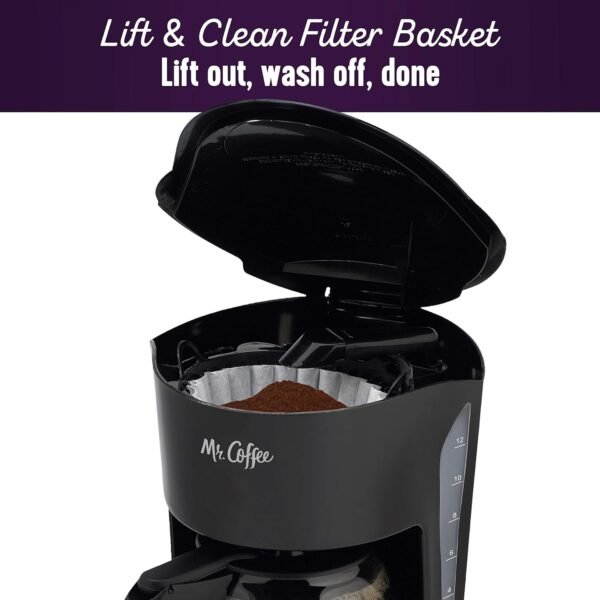
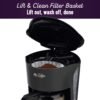
The removable basket filter lifts out in one piece so grounds go straight into the trash. Cleanup is that plus rinsing the carafe.
What is absent shapes the routine more than what is present. There is no clock, so the machine cannot start itself, and coffee happens only when somebody presses the switch. The carafe sits on a hot plate, and a hot plate keeps cooking the coffee after brewing ends, which flattens the pot within an hour. A household that drinks its coffee over a morning rather than in one go is better served by an insulated carafe machine such as the Moccamaster KBT, where the heat source is removed entirely. Noise is not published, and with no grinder and no pump the machine is dominated by a brief boiler sound.
Controls and connected features
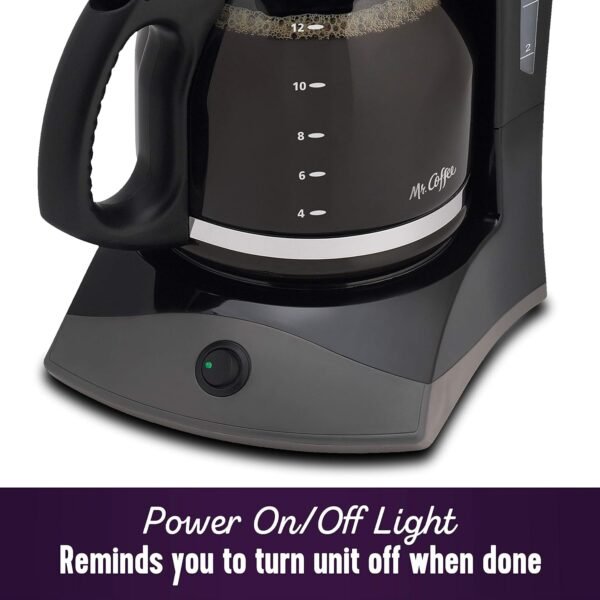
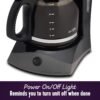
One switch and an indicator light. There is no display, no menu, no app, no Wi Fi, no Bluetooth and no account. Nothing here can be discontinued by a server shutdown, nothing needs updating and nothing needs resetting after a power cut, which is the quiet advantage of a machine with no clock in it.
That is a real benefit rather than a consolation. Every programmable machine in the coffee machines category loses its settings when the power goes, and in an area with an unreliable supply that means arriving at a kitchen where the timer did not fire. A switch operated machine has nothing to forget. The trade is that nobody can schedule it, and if scheduling is the priority then a programmable machine such as the Bella answers a different question.
The listing contradicts itself on this point, giving the special feature as manual and the operation mode as fully automatic on the same page. Neither field carries real information.
Running cost and upkeep
Voltage is recorded as 110, which is the legacy way of writing the North American nominal 120 volt supply and describes an ordinary kitchen outlet. There is no water line, no drain, no gas and no venting, and no wattage or amperage is published, so the rating plate is the reference if the circuit already carries a kettle and a toaster.
The consumable picture is as good as it gets. A permanent reusable filter is included and listed among the special features, so paper filters are optional rather than required and there is no mandatory recurring cost at all. A mesh basket lets more oils and fines through than paper does, so the cup reads slightly heavier, and papers remain available for anyone who prefers a cleaner profile.
No water filter is offered on this model, which removes a cartridge cost and means scale arrives faster in hard water areas. Descaling is therefore the recurring maintenance and no interval is published. The glass carafe is the part most likely to be replaced over the years, and on a design that has been sold since July 2009 and is not flagged as discontinued, replacements are widely stocked and inexpensive. The listing also gives frustration free packaging as the package type, which means less to unwrap and recycle.
One data oddity: the included components field contains the product title rather than a list of parts, which is a common fault in this catalog.
Highlights
- Permanent reusable filter included, so paper filters are optional and there is no mandatory consumable.
- Auto pause for pouring a cup mid brew without spilling onto the hot plate.
- Cord storage built into the body, which keeps a crowded counter tidier.
- Removable basket filter that empties in one motion.
- Nothing to reset after a power cut, because there is no clock.
- Sold since 2009 and not discontinued, so carafes and parts are easy to find.
Things To Consider
- No clock, no timer and no programmable start.
- Glass carafe on a hot plate, which keeps cooking the coffee after brewing ends.
- The recommended uses field says traveling, which does not describe a 12 cup countertop machine.
- The listing calls the machine both manual and fully automatic on the same page.
- No brew strength control and no water filter.
- The included components field repeats the product title instead of listing parts.
Who it is not for
Anyone who wants coffee waiting at a set time should buy a programmable machine, since no accessory adds a clock to this one. Anyone who drinks their coffee slowly needs a thermal carafe, because a hot plate will spoil the second half of the pot. A one person household will waste most of a 12 cup brew and would do better with a four cup machine or a single serve brewer. And anyone who wants brew strength control, a small batch mode or iced settings should look at the Ninja CE251 or the 14 cup Cuisinart instead.