Description
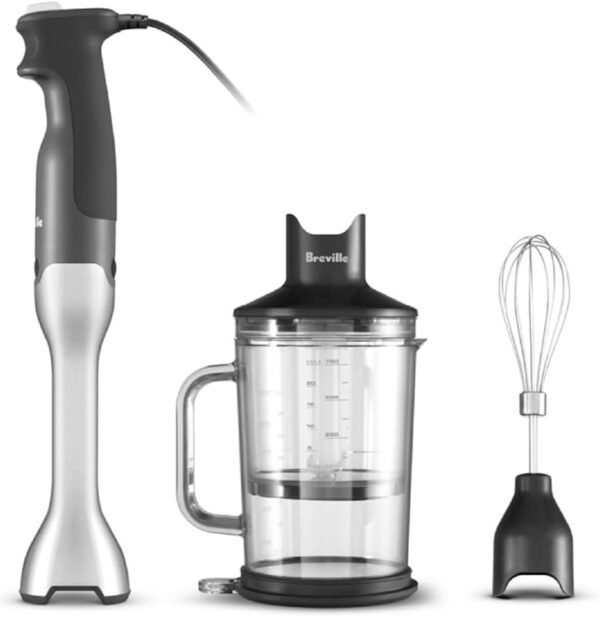
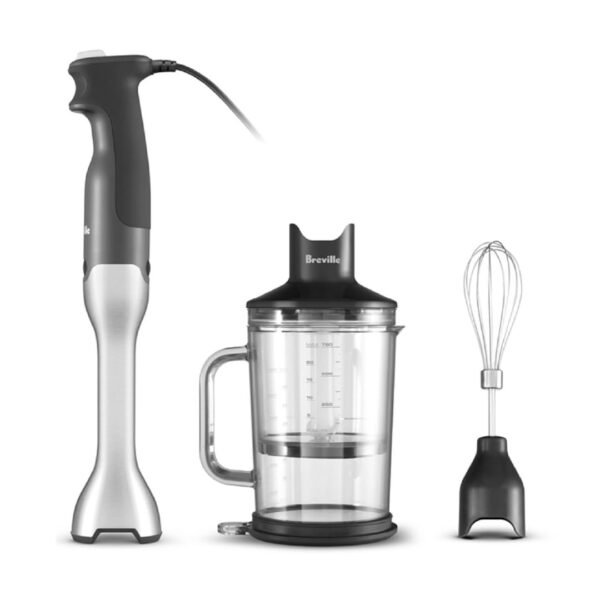
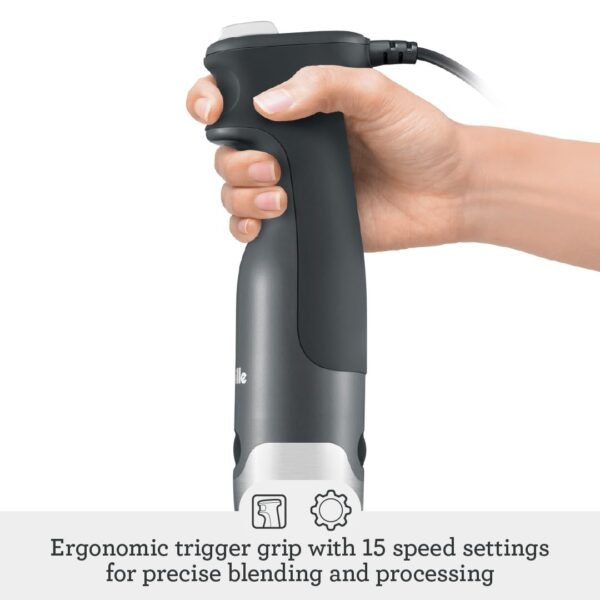
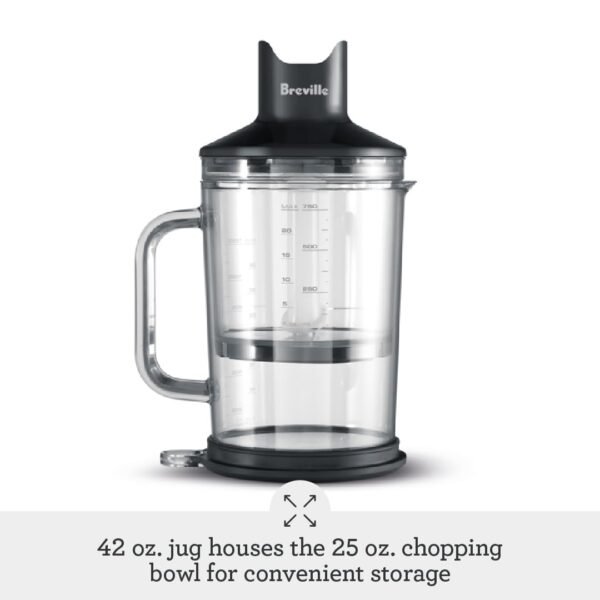
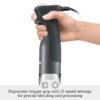
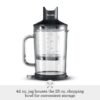
The Breville BSB510XL, sold as the Control Grip, is an immersion blender rather than a jug machine, which makes it a different tool for different work. Breville records a brushed stainless steel finish, dimensions of 6.2 inches deep by 7.5 wide by 12.4 tall, 15 speeds, 120 volts, corded electric power, physical controls, BPA free materials, stainless steel blades, a listed weight of 4.1 pounds, a China country of origin, model number BSB510XL and first availability in June 2011. The description adds anti suction technology, an ergonomic trigger grip, a 42 ounce jug, a whisk attachment, a 25 ounce chopping bowl and a non scratch blending base.
The capacity field on this listing reads 2.6 pounds, which is a weight and not a capacity. It is a data fault, and the volume figures that matter come from the description instead: a 42 ounce jug and a 25 ounce chopping bowl.
What it is and where it fits in a home
A hand blender goes to the food rather than the food coming to it. Soup gets blended in the pot it was cooked in, sauces in the pan, and there is no transferring hot liquid into a jug. That is the entire argument for the format and it is a strong one, because pouring hot soup into a sealed blender is both awkward and the single most common way people burn themselves in a kitchen.
It also stores in a drawer rather than occupying counter permanently, which is why a household with a jug blender such as the Ninja BL610 often owns one of these as well rather than instead. The two do different jobs, and the hand blender category covers the immersion side of that split.
Living with it day to day
The anti suction bell is the design detail that separates this from a basic immersion blender. A conventional blending bell creates suction against the bottom of a pot, which pins the blender down, stops the flow and splashes when you free it. Breville’s bell is shaped to break that suction, so the blender keeps moving through the pot.
15 speeds is far more than most immersion blenders offer and it is more useful here than it sounds. The difference between a slow speed for starting a soup without splashing and a high speed for finishing an emulsion is exactly what an immersion blender needs, because there is no lid containing anything. The trigger grip means speed is held while squeezed, so the machine stops as soon as you release, which matters when the blade is exposed.
The non scratch blending base is the other practical inclusion, because an immersion blender is used directly in nonstick pans and enamel pots that a bare metal bell would mark.
The attachments extend it into food processor territory: a whisk for cream and egg whites, and a 25 ounce chopping bowl for herbs, nuts and onions. Breville publishes no wattage on this listing and no decibel figure, so motor power cannot be compared against the Braun MQ505 or the Braun MultiQuick MQ7035 on paper.
Controls and what works without an app
There is nothing to connect and nothing that should be. No app, no display, no account. A trigger and a speed control are the whole interface.
Physical controls are the right answer for a tool held in one hand over a hot pot. A trigger that stops the blade when released is a safety feature as much as a control, and it cannot be replicated by a touch surface. Fifteen speeds selected by a dial rather than by pressing through modes means the setting is visible without looking at a screen. This is a good example of an appliance where connectivity would add nothing and physical controls do everything.
Running cost and upkeep
No consumables and nothing on a schedule. Electricity is trivial for a tool used in bursts.
The parts that need attention are the blending shaft seal, which is where liquid eventually finds its way toward the motor and is the usual failure point on any immersion blender, the blade itself, and the attachment couplings. Rinsing the shaft immediately after use, ideally by running it in a jug of warm soapy water, is the habit that determines how long one of these lasts.
Breville does not state which parts are dishwasher safe on this listing, which matters on a tool with a whisk and a chopping bowl. The motor body never goes in water on any immersion blender, and the shaft usually detaches, but the specifics should come from the manual.
Electrically, Breville publishes 120 volts and no wattage and no amperage. A hand blender is an undemanding appliance on any circuit, so this is less consequential than the same gap on a heating appliance, but the rating plate remains the only source.
Highlights
- Blends in the pot, so hot liquid never has to be poured into a sealed jug.
- An anti suction bell that keeps the blender moving instead of pinning to the pot base.
- 15 speeds on a trigger grip, far more control than a typical immersion blender.
- A non scratch base, so it can be used in nonstick and enamel pans.
- Stores in a drawer instead of occupying counter space permanently.
Things To Consider
- The capacity field reads 2.6 pounds, which is a weight rather than a volume.
- No wattage is published, so motor power cannot be compared with rivals.
- Breville does not state which parts are dishwasher safe.
- The shaft seal is the usual failure point on any immersion blender and needs prompt rinsing.
- No decibel figure is published.
Who it is not for
Anyone whose main job is smoothies with ice should buy a jug blender from the countertop blender category, because an immersion blender is not a crushing tool. Anyone making nut butters needs a high torque machine with a tamper. Households that want one appliance for everything will find this covers soups and sauces and not frozen drinks. And anyone comparing on published power figures will find nothing here, since Breville publishes no wattage at all, unlike the Breville Super Q which does state a figure.