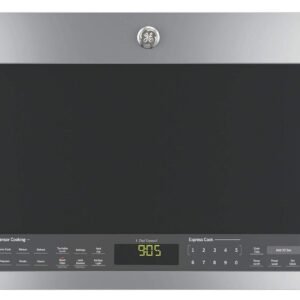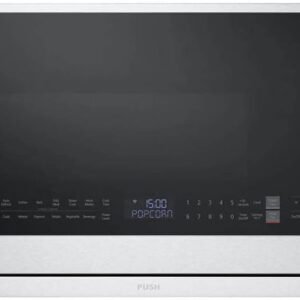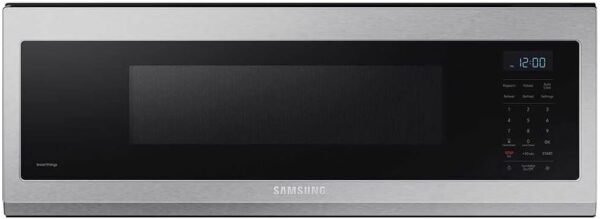
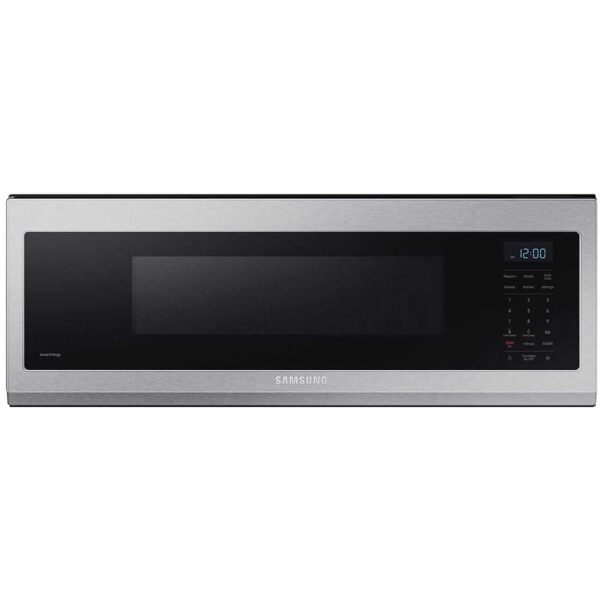
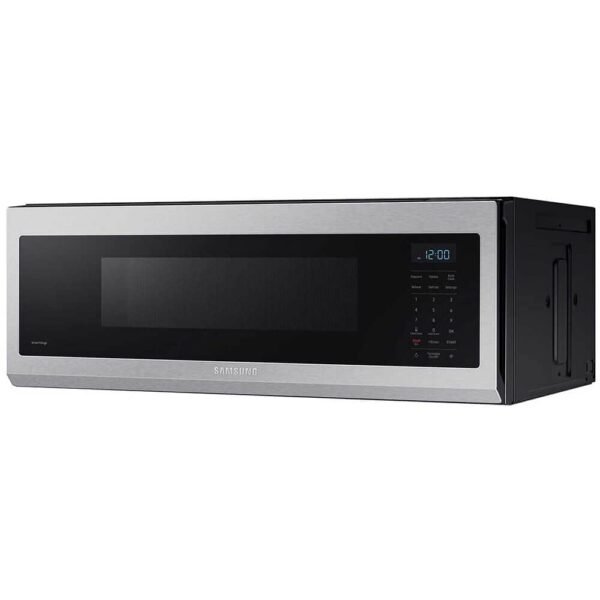
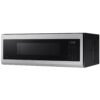
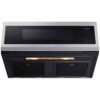
Description
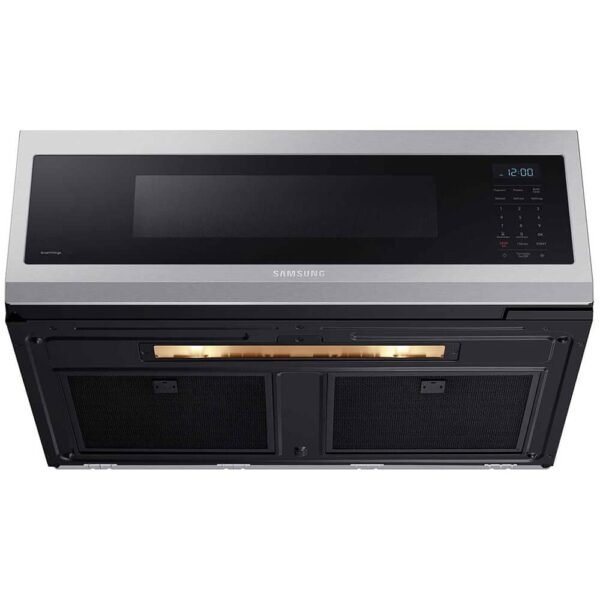
The Samsung ME11A7510DS is the slim profile version of the over the range format, and it makes a trade that most units in this category do not: it gives up cavity volume to gain vertical clearance above the cooktop. Samsung records 1.1 cubic feet, a 1000 watt rating and energy use, a listed weight of 62 pounds, dimensions of 29 by 19 by 9 inches, a stainless steel body, a ceramic enamel interior, auto defrost, and first availability in April 2022. The listing description adds 400 CFM hood ventilation, a fingerprint resistant finish and ten power levels.
What it is and where it fits in a home
The slim format exists for a specific problem. A conventional over the range microwave hangs low enough that a tall pot on a back burner is awkward and a tall cook is working under an overhang. A slim unit sits shallower and shorter, which restores headroom over the cooktop. That is the whole design brief here, and 1.1 cubic feet is what it costs.
In practical terms it suits a kitchen where the cooktop matters more than the microwave: someone who uses tall stockpots, or a household where an over the range unit has previously felt oppressive. Anyone who wants capacity above a range should be looking instead at 1.9 or 2.1 cubic foot units such as the GE PVM9005SJSS, and accepting the lower hanging body that comes with them.
The 400 CFM airflow figure is the notable part of this specification. Most compact over the range units sit at 300 CFM, so a slim body pairing 1.1 cubic feet with 400 CFM is prioritizing the hood job over the microwave job, which is a coherent choice rather than a compromise.
Living with it day to day
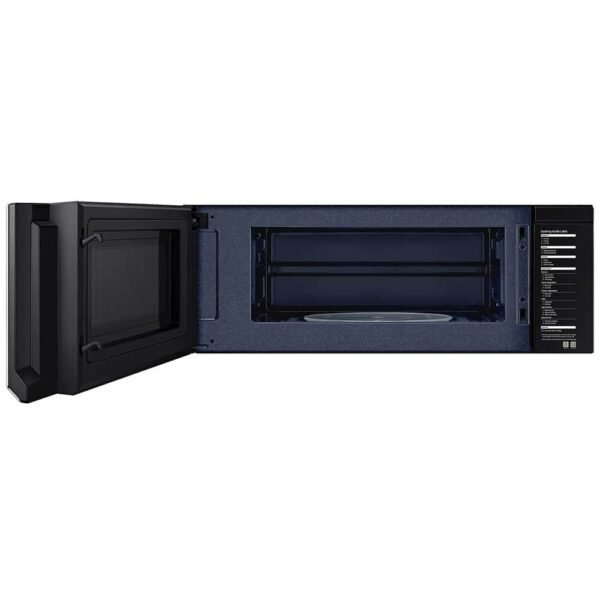
1.1 cubic feet takes a dinner plate on the turntable and a 1.5 to 2 quart dish. It does not take a 9 by 13 pan. For reheating single portions and mugs it is entirely adequate, and for a family casserole it is not, which is a decision to make honestly before buying rather than after delivery. Households that need both capacity and cooktop clearance are better served by separating the two jobs: a hood plus a countertop unit from the countertop category.
The ceramic enamel interior is worth noting. It is a harder, more scratch resistant surface than the epoxy cavities used at the entry level, and it cleans well, though it is more prone to chipping than stainless if something hard hits it. The fingerprint resistant exterior earns its place on any surface mounted at eye level in a kitchen.
Ten power levels give proper manual control, though Samsung does not describe sensor cooking on this model, so reheats are a time and power entry rather than a moisture reading. Auto defrost is listed. Samsung publishes no noise rating and no fan speed count, so how the 400 CFM setting sounds cannot be stated.
Controls and what still works without an app
Nothing on this model is connected. Samsung publishes no Wi-Fi, no SmartThings integration, no app and no voice control for the ME11A7510DS, so the panel is the whole interface and it needs nothing but power. On an appliance mounted permanently into cabinetry that is a reasonable position, since the mounting outlives most software.
The panel carries the ten power levels, auto defrost, the vent fan and the cooktop light. Buyers who want a connected over the range unit in this catalog are looking at the LG MVEL2137F or the LG MVEM1825F, and what they gain is barcode scanning and range sync, at the cost of features that depend on a phone and an account.
Running cost and upkeep
The metal grease filters underneath are the routine job, and with a 400 CFM fan pulling through them they will load up faster than on a 300 CFM unit. That is the honest running cost of better airflow rather than a fault. If the installation recirculates instead of ducting outside, a charcoal filter becomes a consumable, and Samsung does not publish the part number, interval or whether a change indicator exists on this model.
The cooktop lamp is a routine replacement. Over years, the vent fan motor, door switches and turntable roller ring are the wear items. The ceramic enamel cavity wants non abrasive cleaning to avoid chipping the surface.
The electrical data carries a fault that should be named rather than repeated. The voltage field reads 1.2E plus 2 volts, which is scientific notation for 120 volts and an artifact of the data import rather than a specification. No amperage and no dedicated circuit requirement are published, and neither is the duct diameter or the venting configuration. Those are all installation critical and none of them should be assumed. The rating plate and Samsung’s installation manual are the sources.
Highlights
- A slim body that restores headroom over the cooktop, which is the reason the format exists.
- 400 CFM ventilation, which is above the norm for a compact over the range unit.
- Ceramic enamel interior, harder wearing than the epoxy used at the entry level.
- Fingerprint resistant finish on a panel that is touched constantly at eye level.
- Ten power levels and entirely local operation with nothing to pair.
Things To Consider
- 1.1 cubic feet will not take a 9 by 13 pan, which is the cost of the slim body.
- The voltage field is corrupted into scientific notation, and no amperage is published.
- No sensor cooking is described, so reheats are manual time and power entries.
- No noise rating or fan speed count is published for a 400 CFM fan.
- Ceramic enamel chips more readily than stainless if struck.
Who it is not for
Any household that reheats family sized dishes should rule this out on capacity alone. Renters cannot install it. Anyone who wants sensor cooking, convection or connected control is in a different tier, and the GE Profile PVM9179SRSS covers the convection case. And anyone whose real complaint about their current kitchen is the microwave rather than the cooktop headroom is paying for the wrong tradeoff here, since the rest of the over the range category offers far more cavity for the same wall space.