Description
The Bosch HMD8451UC is the most internally contradictory listing in this group, and reading it honestly means separating what Bosch states from what the data claims. Bosch records 1.2 cubic feet, a voltage of 120.00, an energy use figure of 950 watts, a wattage figure of 1500 watts, an installation type of Over-the-Range, an oven cooking mode of Microwave Radiation, a listed weight of 81 pounds, dimensions of 23.87 by 23.37 by 16.31 inches, stainless steel inside and out, auto defrost, a programmable special feature, and first availability in March 2014.
What it is and where it fits in a home
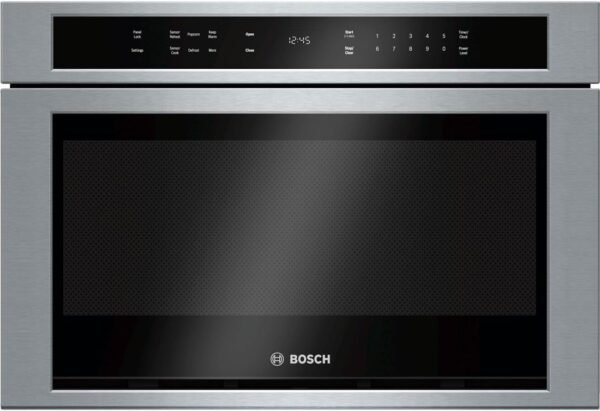
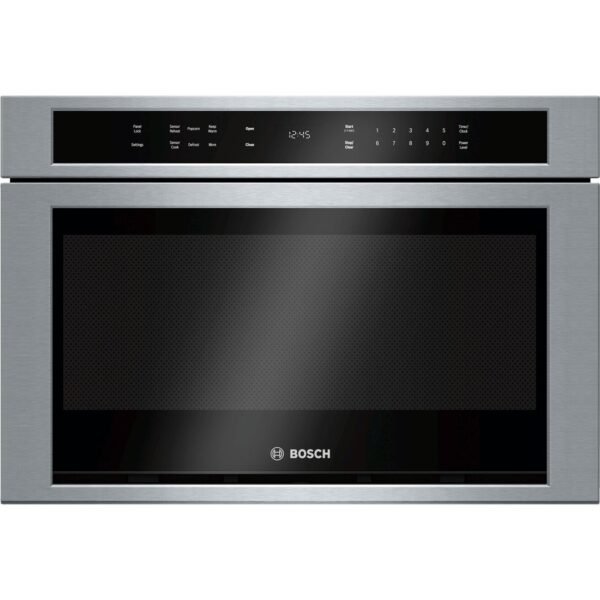
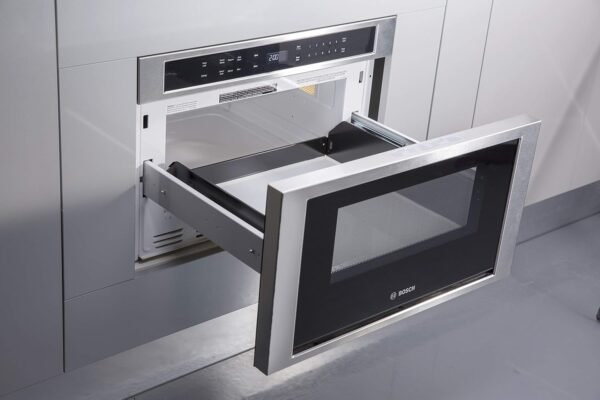
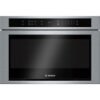
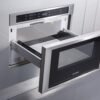
The format question has to come first because it changes the entire installation. The listing categorizes this as over the range, but the product description refers to a drawer that opens and closes at the push of a button, and the published dimensions of roughly 24 inches square by 16 inches are not the shape of a unit built to span a 30 inch range opening. A body 23.87 inches deep and 23.37 inches wide is the footprint of a built in or drawer appliance, not a hood replacement.
Those two descriptions cannot both be right. Anyone considering this should settle the format from Bosch’s own model documentation before planning any cabinetry or ductwork, because an over the range unit and a drawer unit have nothing in common in terms of installation. If it is in fact a drawer, the useful comparison in this catalog is the Sharp SMD2470AS drawer rather than any of the hood replacement models such as the GE JVM3160RFSS.
Living with it day to day
Whichever format it is, 1.2 cubic feet is a modest cavity for an appliance weighing 81 pounds. It takes a dinner plate and a 2 quart dish and it will not take a 9 by 13 pan. That weight to capacity ratio is unusual, and it is consistent with heavy build quality and a stainless cavity rather than with a large interior, which is a fair reading of a Bosch appliance in this segment.
The stainless steel interior is the durable choice. It handles repeated cleaning without losing its finish, unlike the epoxy cavities used at the entry level such as the one in the Samsung ME16A4021AS, and it is the material to want in an appliance expected to last.
Bosch describes automatic sensor programs, touch controls and an LCD display. Sensor cooking ends a cycle on cavity conditions rather than a timer, which takes a daily decision off the cook. No decibel figure is published, no fan speed count and no CFM figure, so if this is genuinely an over the range unit its ventilation cannot be assessed at all from the listing. That is a serious blank on an appliance sold in that category.
Controls and what still works without an app
There is nothing connected on this model. No Wi-Fi, no Home Connect, no app and no voice control are published for the HMD8451UC, so the touch panel and LCD are the entire interface. For a 2014 appliance that is the expected position, and it is one that has aged well: a touch panel and an LCD still work exactly as designed a decade later, which is more than can be said for most connected products of the same vintage.
The touch surface with an LCD display is the notable interface choice. On a drawer format the panel sits on the drawer face at counter height and disappears when closed. On an over the range unit it would sit at eye level. That difference matters for daily use, and it is another reason to settle the format question before buying rather than after. Buyers who want app control in this catalog should look at the connected units in this category.
Running cost and upkeep
The maintenance picture depends entirely on the format. If this is an over the range unit, the grease filters underneath wash, a recirculating installation adds a charcoal filter as a consumable, and Bosch publishes none of the filter details. If it is a drawer or built in unit, there are no filters at all and upkeep reduces to cleaning the cavity and maintaining the drawer mechanism.
The stainless interior is easy to keep, and the wear items in either format are the door or drawer mechanism, the interior lamp, the touch panel and the turntable assembly if fitted. At 81 pounds, removing this appliance for any service is a genuine two person job with proper support, and that weight is worth confirming against the cabinet or mounting arrangement before installation.
The electrical data contains a contradiction that should be named rather than resolved by guessing. Bosch records the energy use as 950 watts and the wattage as 1500 watts. Those are two different numbers for the same appliance and the listing does not label which is the cooking output and which is the input draw. The voltage reads 120.00, which is a plain 120 volts written with unnecessary decimal places rather than a fault. No amperage and no dedicated circuit requirement are published. On an appliance of this weight and draw, the circuit is not something to assume, and the rating plate plus Bosch’s installation documentation are the only sources that should be used.
Highlights
- Stainless steel inside and out on a heavily built appliance.
- Automatic sensor programs remove the timing decision from routine reheats.
- Touch controls with an LCD display, and no dependency on any app or account.
- Voltage is published, which several listings in this catalog do not manage.
- A Bosch service network, which matters on an appliance this heavy to replace.
Things To Consider
- The listing calls it over the range while the description refers to a push button drawer.
- Wattage is recorded two ways, 950 and 1500 watts, without labeling which is output.
- No CFM figure or fan speed count is published, despite the over the range categorization.
- 81 pounds for a 1.2 cubic foot cavity is heavy relative to what it holds.
- No amperage or dedicated circuit requirement is stated.
Who it is not for
Nobody should buy this to replace a range hood without first confirming the format and the airflow figure directly with Bosch, because the listing does not support either. Anyone who needs a large cavity should look at 2.1 cubic foot units such as the GE PVM9005SJSS. Renters cannot install it in either format. And anyone who wants a straightforward specification to plan an installation from will find this listing frustrating, in which case a clearly documented unit from the countertop category is the calmer choice.