
Description
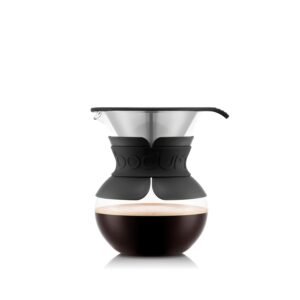
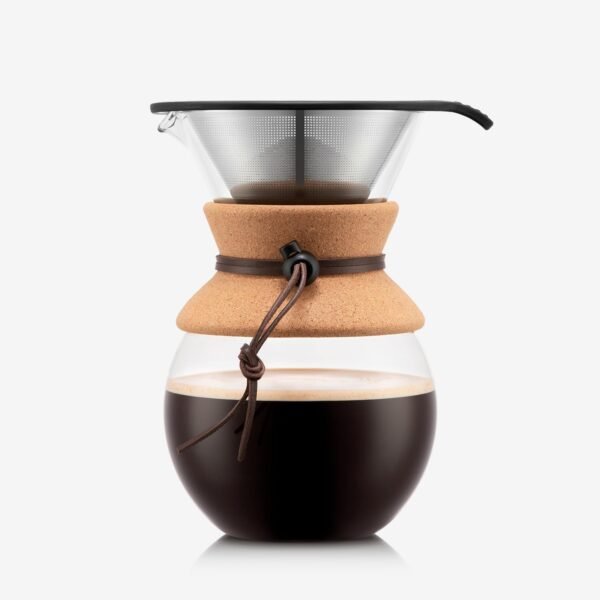
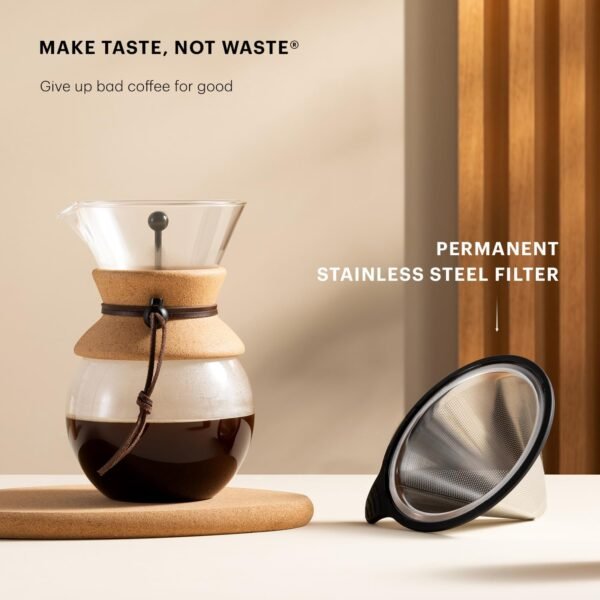
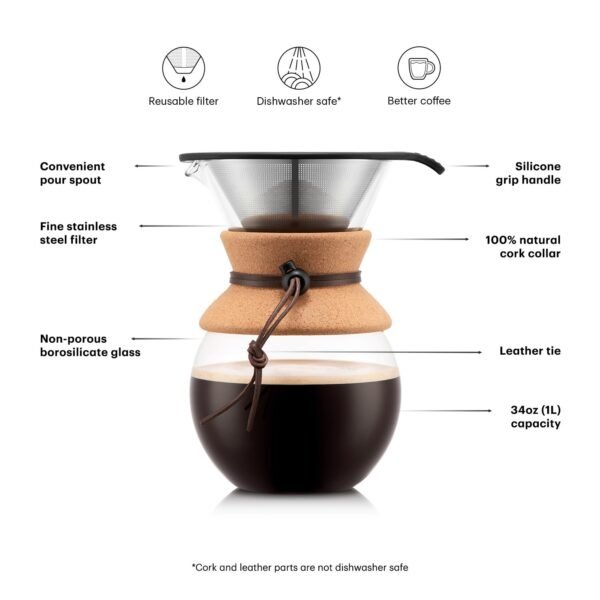
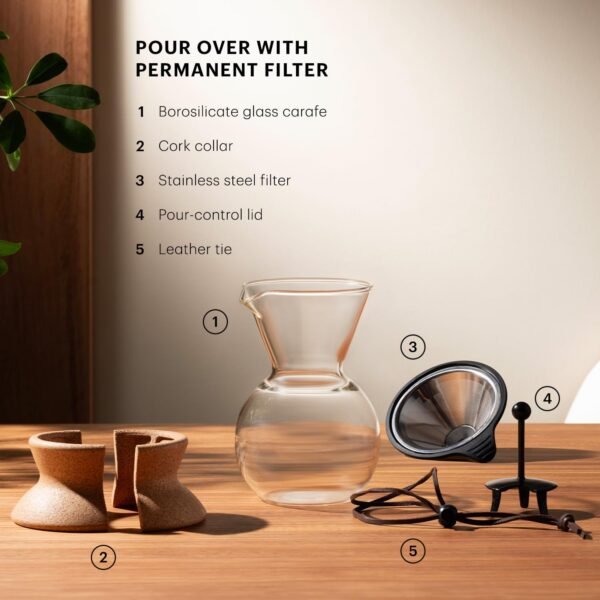
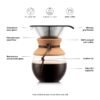
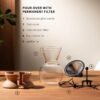
Bodum’s cork banded pour over is a single piece of borosilicate glass with a stainless mesh filter that drops into the neck and a cork sleeve around the middle. There is no paper anywhere in it, and that one decision determines how the coffee tastes, how it is cleaned and what it costs to run.
What it is and where it fits
This is a manual brewer for a counter or a table rather than a bag. The listing gives the size as 5.63 inches deep by 8 inches wide by 6.5 inches high and the weight as 1.21 pounds, and it is made in Portugal, which is where Bodum’s glass comes from. The cork band is functional rather than decorative: it is the part that gets held when the glass is full of near boiling coffee.
The product copy describes eight servings. The listing does not state a volume in ounces, and manufacturers in this category commonly count a serving as four or five ounces rather than a mug, so eight servings is closer to a liter than to eight mugs. Anyone matching this to a household should treat the serving count as a rough guide and check the carafe markings.
Living with it day to day
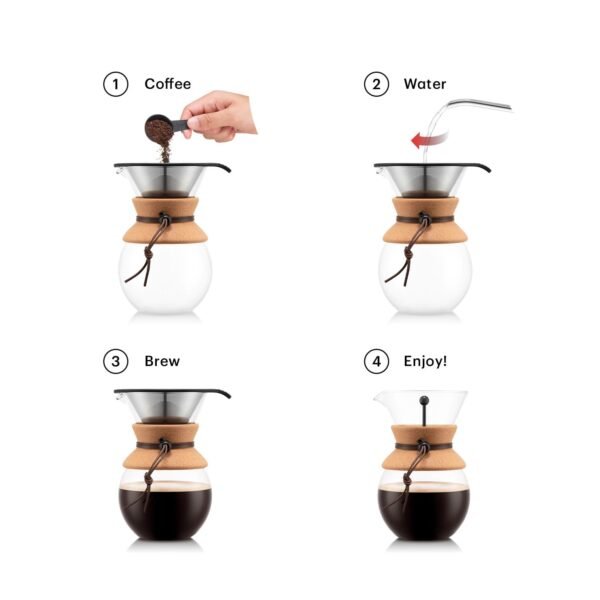
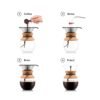
The routine is three to four minutes of pouring hot water over grounds in a slow spiral, then lifting the filter out and serving. It uses no power, makes no noise, needs no counter space when stored and has nothing that can fail electronically.
The metal filter changes the cup in a way that is easy to describe and hard to reverse. Paper absorbs coffee oils and traps the finest particles, which is why paper filtered coffee reads clean and light. A mesh screen lets both through, so the result is heavier and rounder with a small amount of sediment at the bottom of the cup, closer in character to what a press produces than to what a paper filtered V60 makes. That is a preference, not a defect, and it is the main reason to choose this over a cone.
Glass is the practical trade. Borosilicate handles the thermal shock of boiling water going into a cold vessel, which ordinary glass does not, but it still breaks when dropped, and a one piece carafe cannot be partially replaced. Cleanup is a rinse plus scrubbing the mesh, and mesh screens need attention: coffee oils build up in the weave and go rancid, which taints later brews in a way a discarded paper filter never can.
Controls and connected features
None. No power, no switch, no display, no app, no firmware and no account. The variables are grind size, dose, water temperature and pour rate, and every one of them lives with the person holding the kettle. Nothing here can lose software support and there is nothing to update.
One entry in the specification block is worth ignoring. The listing records a coffee filter size of number 4, which is a paper filter designation, on a brewer whose whole point is a permanent metal screen. It is possible to use a paper filter in a mesh basket, but no paper is included and none is required, and the field looks like a leftover from a different product.
Running cost and upkeep
There is no electrical or plumbing requirement whatsoever. No voltage, no plug, no amperage, no gas, no venting, no water line and no drain. A kettle is the only companion equipment and the running cost is coffee alone.
With a permanent filter there is no consumable at all, which over five years is a meaningful difference from any pod machine in the single serve brewers range and a modest one against a machine that uses cheap paper cones. There is nothing to descale because nothing heats water, no seals on a schedule and no parts that wear on a timetable.
The two things that will eventually end this product’s life are the glass and the mesh. Glass breaks, and Bodum sells replacement carafes for many of its designs, though this listing does not confirm availability for this model. Mesh screens clog and distort with years of use and are the more likely first replacement. Both are worth checking on before treating a one piece glass brewer as a permanent purchase. First availability is given as October 31, 2020.
Highlights
- Permanent stainless mesh filter, so there is no paper to buy and no consumable at all.
- Heat resistant borosilicate glass that handles boiling water poured into a cold carafe.
- Cork band that stays cool enough to hold when the carafe is full.
- Heavier, oilier cup than paper filtered brewing, for anyone who prefers that profile.
- No power, no plumbing, no descaling and nothing that can lose support.
- Made in Portugal at just over a pound.
Things To Consider
- Volume is described only as eight servings, and a serving in this category is usually four to five ounces.
- A mesh filter lets fines through, so there is sediment in the bottom of the cup.
- Coffee oils build up in the mesh and go rancid if it is not scrubbed properly.
- One piece glass construction, so a break ends the carafe rather than a part of it.
- The listing records a number 4 paper filter size on a brewer that uses no paper.
- Every cup is fully manual, and the result depends on pour technique.
Who it is not for
Anyone who wants a clean, sediment free cup should use paper, and the cones in the pour over coffee makers section do exactly that for less money. Anyone who wants coffee waiting when they get up should buy a machine with a timer. It is the wrong brewer for a household with children and a stone counter, where a stainless cone survives what glass does not, and the wrong brewer for anyone brewing on the move, which is what the OXO Rapid Brewer is built for. Anyone who likes the heavier mesh filtered profile but wants more of it at once should compare it against a stoneware French press.