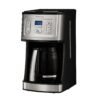
Description
Fourteen cups is the largest carafe in this part of the catalog, and it is the reason to look at this machine rather than any of the twelve cup alternatives. It adds a 24 hour timer and a brew strength selector, which are the two controls that matter most on a drip machine, and it publishes a set of dimensions that cannot possibly be correct.
What it is and where it fits
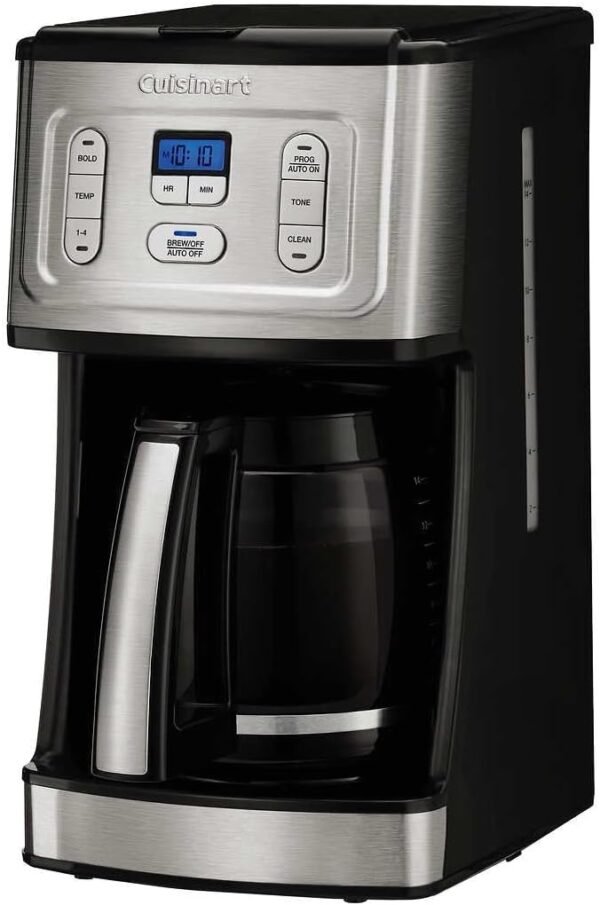
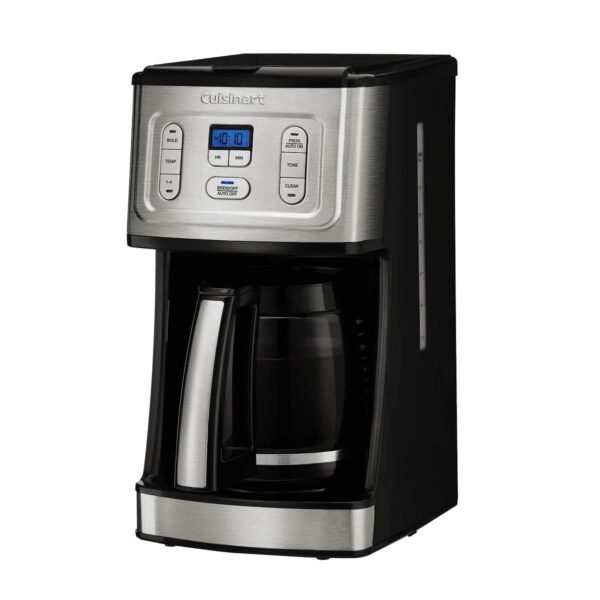
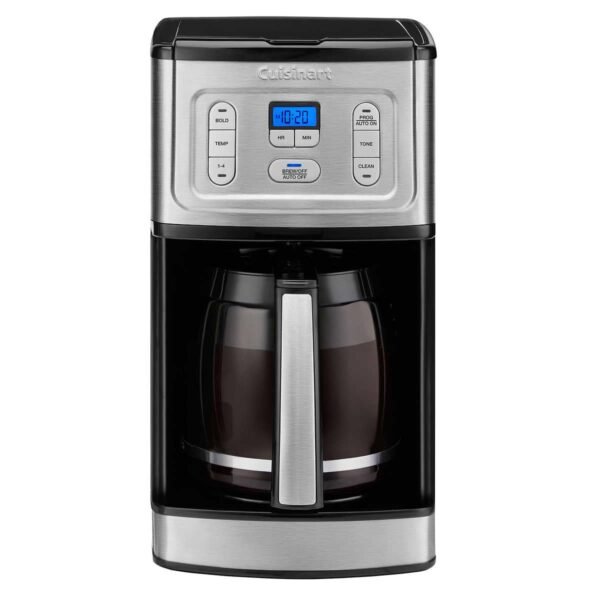
This is a countertop drip maker in a silver and black stainless finish, aimed at a household or an office where a pot gets emptied. The listing gives the recommended uses as office and home, and both fit: a 14 cup carafe covers a meeting or a family breakfast in one brew rather than two.
The published dimensions are 5 inches deep by 5 inches wide by 12 inches high. That is not a 14 cup coffee maker. A carafe holding fourteen cups is physically wider than five inches on its own, and the machine has to hold that carafe plus a reservoir plus a brew basket. Those numbers describe something else, possibly a component or possibly nothing at all, and anyone measuring a counter should plan for a full sized machine roughly comparable to a 12 cup Mr. Coffee and verify on arrival. The listed weight of 7 pounds is at least plausible.
Living with it day to day
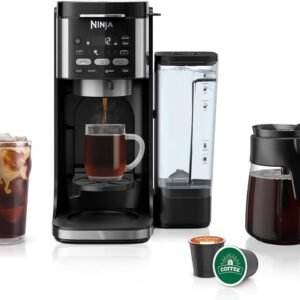
A large carafe changes the calculation in both directions. It means one brew serves a group, which is the whole point. It also means that when only two cups are wanted, the machine brews them through a basket sized for fourteen, and the water passes too fast through too little coffee. Machines that address this have a dedicated small batch mode, such as the Ninja CE251, and nothing in this listing suggests this one does.
Brew strength adjustment from regular to bold is the control that gets used. On a drip machine that setting slows the water so it spends longer in the grounds, producing a stronger cup from the same dose rather than a larger one, and it is genuinely useful for anyone who finds standard drip coffee thin.
The 24 hour advance start is the other daily feature. Grounds and water go in the night before, and the pot is finished before anyone reaches the kitchen. The carafe sits on a heating plate that the product copy says holds for up to four hours, and that is a limit rather than a promise of quality: coffee held on heat keeps cooking and flattens within an hour whatever the plate is set to. Noise is not published.
Controls and connected features
A control panel with a clock, a program function and a strength selector. There is no app, no Wi Fi, no Bluetooth and no account anywhere on this listing, so nothing depends on a phone and nothing can be removed by a firmware change. Every setting lives in the machine.
The cost of a clock is that it needs resetting after a power cut, which is worth weighing for anyone whose supply is unreliable. The benefit is that a machine with a timer is used differently from one without: the coffee happens whether or not anyone remembers to start it, and that is the difference between a machine that gets used every day and one that gets used at weekends.
Running cost and upkeep
The listing publishes no voltage, no wattage and no amperage, which is a gap on a heating appliance and should not be filled with a guess. The format is not in question: a corded countertop machine on a standard kitchen outlet, with no water line, no drain, no gas and no venting. The rating plate on the base is the only reliable source, and it is worth reading, because a 14 cup machine has a larger element than a small one and a shared circuit is more likely to matter.
The consumable picture is contradictory on the page. The filter type field says paper, while the coffee input type field says reusable basket. Those describe two different arrangements, and the practical answer is that most machines of this type accept both, with paper giving a cleaner cup and a mesh basket removing the recurring cost. Whichever ships in the box, the other option remains available.
Descaling is the recurring maintenance and no interval is published. No water filter is listed for this model, which saves a cartridge cost and speeds up scale in hard water areas. The glass carafe is the part most likely to be replaced, and on a large capacity machine a replacement carafe is a specific part rather than a generic one, so it is worth confirming availability. First availability is given as February 1, 2024, and the manufacturer field reads Cuisinart Brew rather than simply Cuisinart, which is a cataloging artifact.
Highlights
- 14 cup carafe, the largest in this part of the catalog, so one brew serves a group.
- Adjustable brew strength from regular to bold, which changes contact time rather than volume.
- 24 hour programmable start, so the pot can be ready before anyone is awake.
- Heating plate with a stated hold of up to four hours.
- Stainless finish and a plausible 7 pound weight for a machine of this size.
- No app, no account and nothing that can lose software support.
Things To Consider
- The published dimensions of 5 by 5 by 12 inches are impossible for a 14 cup machine.
- No voltage, wattage or amperage is published for a large heating appliance.
- The filter type field says paper while the coffee input field says reusable basket.
- No small batch mode is mentioned, so brewing two cups in a 14 cup basket will be weak.
- A glass carafe on a heating plate keeps cooking the coffee after brewing.
- Replacement carafes for large capacity machines are model specific and worth confirming.
Who it is not for
Anyone brewing for one or two people should not buy a 14 cup machine, because most of it goes down the sink and small batches come out weak. Anyone who wants coffee to hold its quality for hours needs a thermal carafe such as the one on the Cuisinart DCC-1170, not a heating plate. Anyone who wants pods, iced modes or milk drinks will find none of them here, and the single serve brewers range or the multi format machines in the coffee machines category cover those instead.