Description
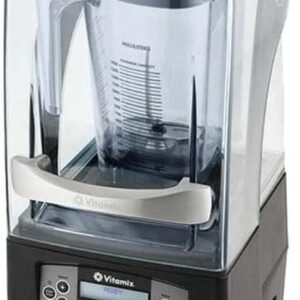
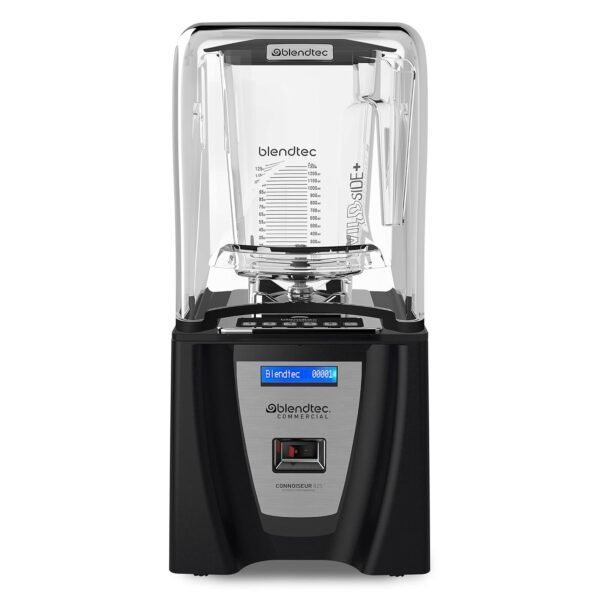
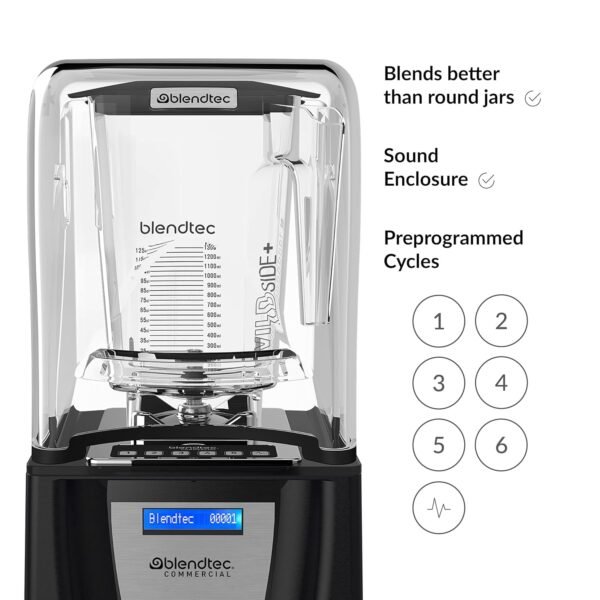
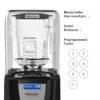
The Blendtec Connoisseur 825 is a commercial machine that has ended up in a domestic catalog, and it should be read as one. Blendtec records a 2750 milliliter capacity, dimensions of 9.4 inches deep by 9.4 wide by 13.4 tall, a black color and multiple speeds. The listing description adds a sound enclosure, customizable preprogrammed cycles, a patented thick stainless steel blade without sharp edges, and a build intended for professional use.
Two of the specification entries on this listing are malformed and repeat their own field names as values. The material appears to be stainless steel with plastic and copolyester, and the weight appears to be 16 pounds, but both are recorded in a way that makes them unreliable, so they are reported here as indicated rather than confirmed.
What it is and where it fits in a home
Blendtec designed this for smoothie bars and cafes, where a blender runs dozens of times an hour next to customers. That origin explains every design decision on it, and it also explains why it makes sense in a specific kind of home: an open plan house where the kitchen is the living room, or a household that blends early while others sleep.
The dimensions are the surprise. At 13.4 inches tall including the enclosure it is shorter than nearly every jug blender in this catalog, including the Ninja BL610 at 15.94 inches and the Ninja BN701 at 17.5 inches, so it may actually fit under a wall cabinet where they will not. The 9.4 inch square footprint is compact for the capacity.
2750 milliliters is about 93 fluid ounces, which is larger than the 72 ounce pitchers common here. That is a commercial jar size.
Living with it day to day
The sound enclosure is the feature, and it is a genuinely different ownership experience rather than a marginal improvement. A high powered blender without one is loud enough to stop conversation and wake a house. An enclosed one is a machine you can run at six in the morning. Blendtec publishes no decibel figure on this listing, which is a real omission on a machine whose defining feature is noise reduction, so the improvement should be understood as real in kind rather than quantified.
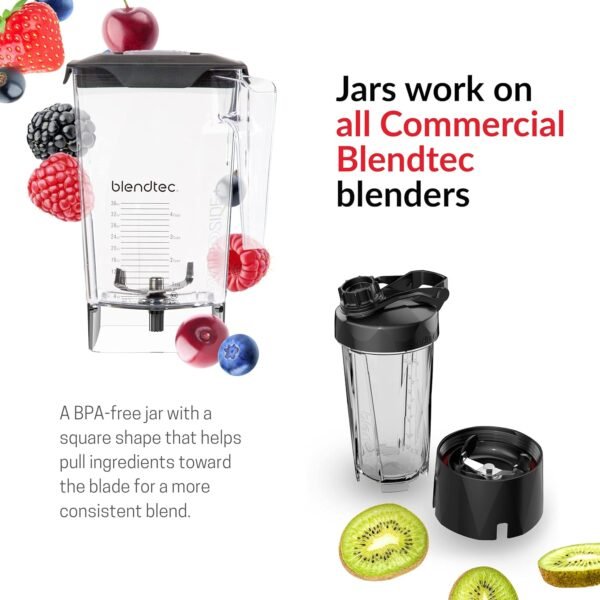
The blunt blade is the other design decision worth understanding. Blendtec uses a thick, unsharpened blade that works by speed and impact rather than by cutting. It never needs sharpening, it does not dull, and it is safer to handle when washing than the sharp stacked assemblies used by crushing blenders. Blendtec machines also do not use a tamper, unlike the Vitamix approach in the Vitamix VM0197 Explorian, because the jar geometry is designed to fold ingredients back into the blade.
Customizable preprogrammed cycles are the commercial feature: a cafe sets its own programs so every operator produces the same drink. At home that translates into consistency without thinking, which is the same benefit Auto-iQ offers on the Ninja machines by a different route.
The daily cost of a commercial machine at home is that it is built for throughput rather than for a household. The enclosure has to be opened and closed each time, and it is another surface to wipe.
Controls and what works without an app
Nothing here is app connected. No Wi-Fi, no phone, no account. The programs live in the base and run from the panel, and they will keep running with no network.
That matters more on a machine with programmable cycles than on a simple one, because a programmable machine that stored its settings in a cloud service would be a genuine liability over a decade. Blendtec keeps it local. The distinction is the same one worth drawing on the Vitamix A3300, whose wireless feature is container recognition between machine and jar rather than a network service.
Running cost and upkeep
No consumables, no filters and nothing on a schedule. The blunt blade never needs sharpening or replacing for dullness, which removes the most common blender wear item entirely.
The parts that do wear are the jar seal, the drive coupling and, on an enclosed machine, the enclosure hinge and latch. Commercial machines are generally built for parts replacement rather than disposal, which is an ownership advantage at this level, though Blendtec does not publish a warranty term on this listing, which is a gap on a machine of this class.
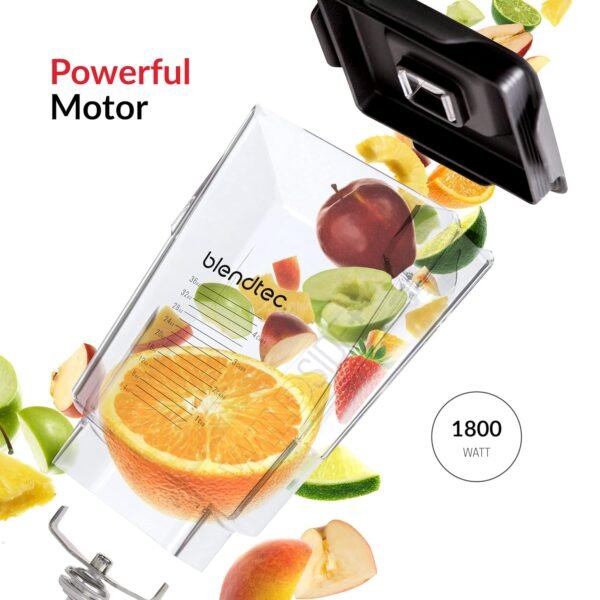
Electrically, this listing publishes no voltage, no wattage, no amperage and no horsepower. For a machine sold on motor capability that is a complete blank, and it means it cannot be compared on paper against the 1800 watt figures quoted by Ninja or the 3.75 horsepower quoted by the Waring Commercial CB15. Commercial blenders can draw substantially more than domestic ones, and some commercial models require a dedicated circuit, so this is precisely the case where the rating plate must be read before the machine is plugged into a kitchen outlet. Do not assume it behaves like a domestic blender on a shared circuit.
Highlights
- A sound enclosure, which is the only real answer to blender noise in an open plan home.
- At 13.4 inches tall it may fit under a wall cabinet where taller jug blenders will not.
- A blunt blade that never dulls and is safer to handle when washing.
- Customizable programs stored locally in the base with no network involved.
- A 2750 milliliter jar, larger than the 72 ounce pitchers common in this category.
Things To Consider
- No voltage, wattage, amperage or horsepower is published at all.
- Two spec fields are malformed and repeat their labels as values.
- No decibel figure, on a machine whose defining feature is noise reduction.
- No warranty term is published, which is unusual at this level of machine.
- It is a commercial design, so it is built for throughput rather than for a domestic kitchen.
Who it is not for
Anyone making single drinks should look at the personal size blender category rather than a 93 ounce commercial jar. Anyone who wants a tamper for very thick mixtures should note that Blendtec does not use one. Anyone with a tight kitchen circuit should confirm the electrical requirement first, given that this listing publishes nothing. And anyone who does not specifically need the noise reduction is paying for an enclosure, in which case the machines in the countertop blender category cover the blending for less complexity.