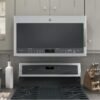
Description
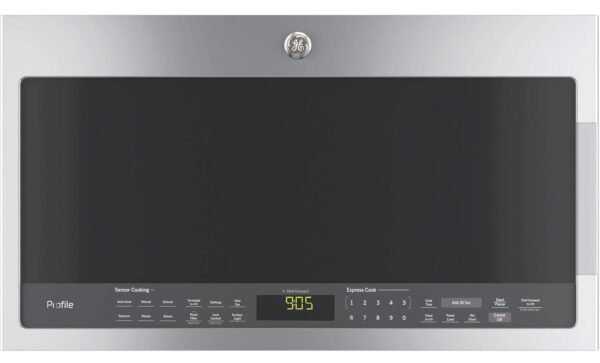
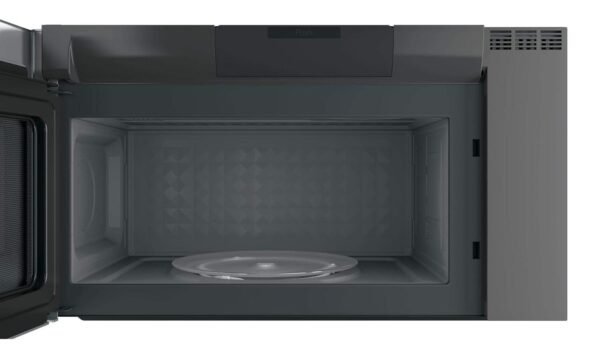
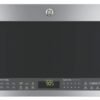
The GE PVM9005SJSS pairs one of the larger cavities in the over the range format with a serious ventilation figure, which is a more coherent combination than several units in this group manage. GE records 2.1 cubic feet, 120 volts, an energy use figure of 1050 watts, a wattage figure of 1000 watts, a listed weight of 58 pounds, dimensions of 15.56 by 29.88 by 16.44 inches, stainless steel inside and out, microwave defrost, and first availability in July 2015. The listing description adds a three speed 400 CFM venting system and sensor cooking controls.
What it is and where it fits in a home
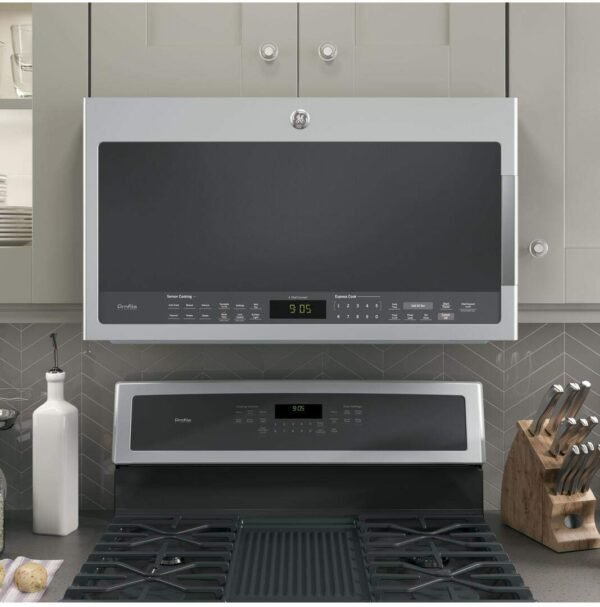
This is the over the range unit for a household that actually cooks. 400 CFM on three speeds is a meaningful step above the 300 CFM entry class occupied by the GE JVM3160RFSS, and 2.1 cubic feet is at the top of the capacity range for the format. Together they address the two most common complaints about over the range microwaves: not enough airflow, and not enough room.
It fits a standard 30 inch range opening. GE publishes 120 volts but no amperage, no breaker size, no duct diameter and no statement of whether it ships configured to duct outside or recirculate. Those four blanks are the installation, and none should be filled by assumption. The installation manual is the source, and the existing duct run in the wall or ceiling is usually the constraint that decides the job.
Living with it day to day
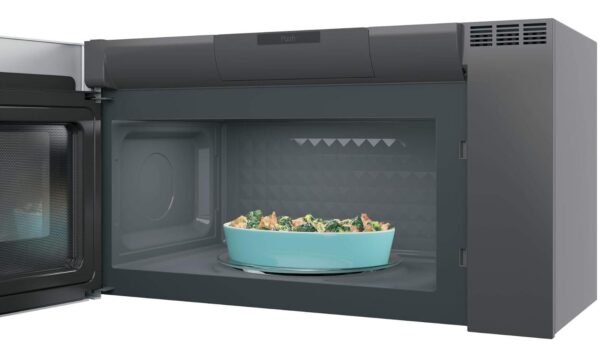
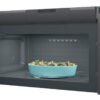
2.1 cubic feet takes a 9 by 13 pan flat, a large platter with turntable clearance, and tall containers without touching the roof. In everyday terms, that is the difference between reheating a family dish in one go and doing it in two. It is also the cavity size at which the format’s ergonomic problem gets sharper: a full 9 by 13 dish of hot food coming down from above a range at shoulder height is heavy, and this is the class of appliance where a Sharp SMD2470AS drawer at counter height starts to look sensible instead.
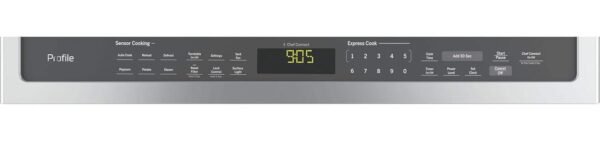
Sensor cooking ends a reheat on cavity humidity rather than a timer. Stainless steel inside is a genuine long term advantage over epoxy cavities, since it takes repeated cleaning without losing its finish.
The three speed 400 CFM fan is the daily feature that matters most. Three speeds means there is a usable middle setting rather than a choice between too little and too much, and 400 CFM will actually pull the steam from a pot of pasta rather than watching it go past. GE publishes no sone or decibel figure, so the loudness of the top speed is not something to state.
Controls and what still works without an app
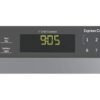
There is nothing connected on this model. No Wi-Fi, no app, no voice, no scan to cook and no cross appliance sync feature. The panel is the entire interface, and sensor cooking, the vent speeds, the cooktop light, defrost and all manual power levels work with the power on and nothing else.
Given the model dates from 2015, that is worth reading as a feature rather than an omission. Connected appliances from that era have in many cases already outlived their app platforms, while a keypad and a magnetron have not. Buyers who do want connectivity in this catalog are looking at the connected models in this category, and the tradeoff there is clear enough.
Running cost and upkeep
A 400 CFM fan pulls more through the grease filters than a 300 CFM one does, which means the metal filters underneath need washing more often, not less. That is the honest running cost of better ventilation. If the installation recirculates rather than ducting outside, the charcoal filter is a consumable, and GE does not publish the part number, the interval or whether this model has a change indicator, unlike the GE JVM7195SKSS which does publish one.
The cooktop lamp is a routine replacement. Longer term, the vent fan motor, door switches and turntable roller ring are the wear items. At 58 pounds and mounted overhead, any service work is a two person job.
The electrical data has a small contradiction worth naming. GE records the energy use as 1050 watts and the wattage as 1000 watts, which are two different figures for the same appliance. One is likely the input and the other the cooking output, but the listing does not label them, so neither should be repeated as the cooking power. Voltage is published as 120. Amperage, breaker size and any dedicated circuit requirement are not, and neither is an Energy Star statement or an annual consumption figure, so no efficiency claim can be made here in either direction.
Highlights
- 400 CFM on three speeds, which is genuinely useful airflow rather than the entry level figure.
- 2.1 cubic feet takes a 9 by 13 pan flat, which most units in this format will not.
- Stainless steel inside and out, which holds up to years of cleaning.
- Sensor cooking with no app, account or network anywhere in the chain.
- Voltage is published, and the capacity and airflow figures are matched sensibly to each other.
Things To Consider
- The wattage is recorded two ways, 1050 and 1000 watts, without labeling which is output.
- Amperage, breaker size, duct diameter and vent configuration are all unstated.
- A higher airflow fan means grease filters need washing more often, not less.
- No noise rating is published for the fan at any speed.
- A full 2.1 cubic foot dish lifted down from above a range is heavy and awkward.
Who it is not for
Shorter cooks and anyone with shoulder problems should think hard before putting the largest cavity in this format above a range, and the drawer or countertop routes in countertop microwave ovens solve that properly. Renters cannot install it. Anyone who wants convection or air fry needs a combination unit such as the GE Profile PVM9179SRSS rather than this. And buyers who specifically want app control or cooktop sync will not find either here, since this is a deliberately unconnected appliance from a pre app generation.