


Description
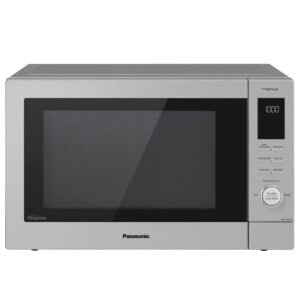
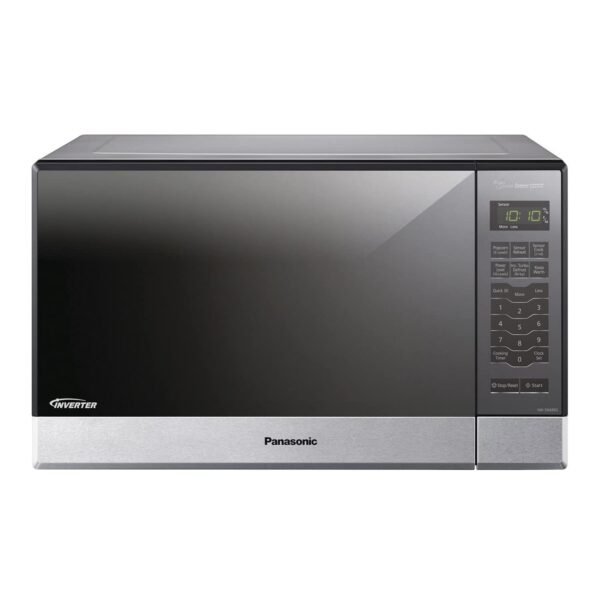
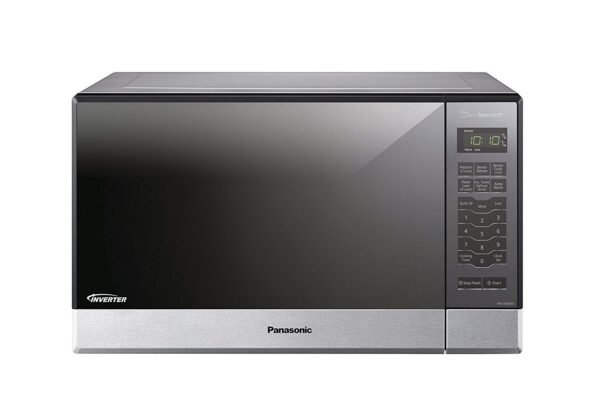
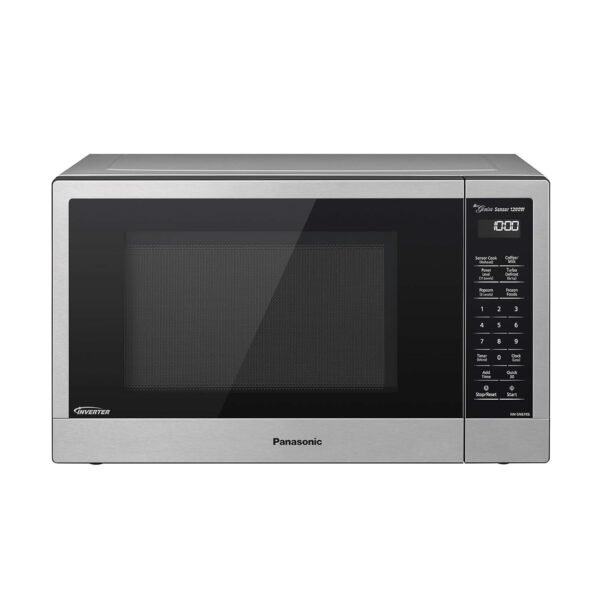
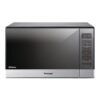
The Panasonic NN-SN686S is a countertop microwave whose main claim is not capacity but how it delivers power. Panasonic records 1.2 cubic feet, a wattage figure of 1480 watts, a stainless steel or silver finish, a safety lock, dimensions of 15.8 inches deep by 20.7 wide by 12.2 tall, countertop installation and a residential recommendation. The listing description adds Inverter Technology, the Genius Sensor and Turbo Defrost.
What it is and where it fits in a home
At 1.2 cubic feet with a footprint just under 21 inches wide, this is a mainstream countertop microwave that suits a family kitchen as a primary appliance or a larger household as a second one. Its dimensions are more compact than several rivals for the same cavity size, which is a real advantage in a kitchen where counter run is the constraint. Compared with the Farberware FM11BKBSS at 1.1 cubic feet or the Sharp SMC2266KS at 2.2, it sits in the middle of the field on capacity and near the front on technology.
The wattage figure of 1480 watts on the listing needs explaining rather than repeating. Countertop microwaves are normally described by their cooking output, which for a cavity this size sits in the 1000 to 1250 watt range, while the input draw is higher. A single 1480 watt figure with no label is therefore ambiguous, and the listing does not distinguish output from input anywhere. Do not read it as cooking power.
Living with it day to day
Inverter power delivery is the feature that changes daily cooking, and it is worth understanding what it actually does. A conventional microwave at 50 percent power runs the magnetron at full power for half the time and off for the other half. An inverter design instead runs the magnetron continuously at a genuinely reduced level. In practice that means softening butter, melting chocolate, simmering a sauce and reheating delicate leftovers behave differently from a cycling design, because the food is not being repeatedly blasted and rested.
That matters more than an extra 200 watts of peak output for anyone who uses reduced power settings at all. For someone who only ever presses two minutes on full, it changes nothing. This is the honest way to think about the feature: it improves a specific set of tasks rather than making everything faster.
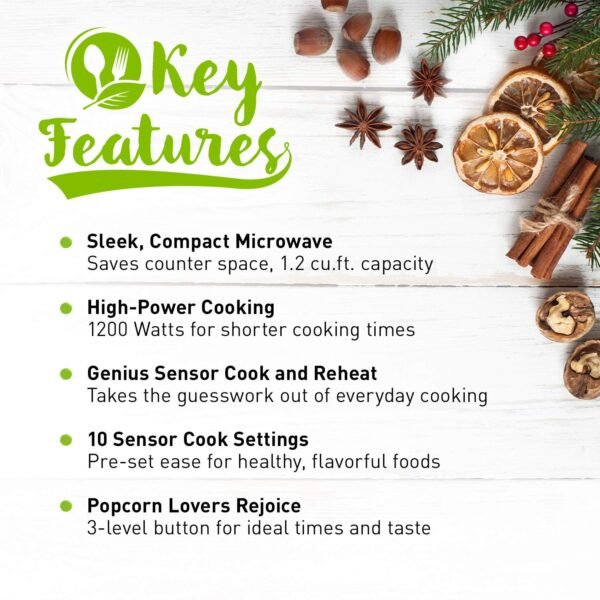
The Genius Sensor handles the reheat decision by reading moisture in the cavity, and Turbo Defrost is a separate cycle. 1.2 cubic feet takes a dinner plate with rotation clearance and a 2 quart dish. Panasonic does not publish a turntable diameter or a decibel figure on this listing, so plate fit and noise both remain unstated.
Attention it needs is minimal and predictable. The turntable and roller ring lift out for washing, the cavity wants wiping before splatters set, and there is nothing else on a schedule. Because it sits on a counter rather than above a range, loading and unloading happen at working height, which is a quiet ergonomic advantage over the whole over the range class and one that people who have used both formats tend to notice immediately.
Controls and what still works without an app
There is nothing connected on this model. No Wi-Fi, no app, no voice control, no barcode scanning. The keypad is the entire interface and everything works with the power on and nothing else, which on an appliance expected to run for a decade is a position with real merit rather than a shortcoming.
The safety lock is listed as a feature, which matters in a household with children given that this is a countertop unit within reach. The sensor and inverter functions all live on the panel. Anyone who wants app control in this catalog is looking at the over the range tier, where the LG MVEL2125F carries it, and there is no countertop equivalent here with those features.
Running cost and upkeep
No filters, no water, no drain, no consumables on any schedule. Upkeep is the turntable in the sink and the cavity wiped down. The wear parts across a long life are the turntable and roller ring, the door latch and switches, and the interior lamp.
One durability point specific to inverter designs is worth noting honestly: the inverter board is an additional electronic component that a conventional transformer microwave does not have, and it is the part most associated with failures on inverter models generally. That is a general observation about the technology, not a Panasonic specification, and nothing in this listing speaks to reliability either way.
On the electrical side, Panasonic publishes the 1480 watt figure and no voltage, no amperage and no circuit requirement. Given the ambiguity about whether 1480 watts describes input or output, and given that the input draw of a microwave this size is substantial, the circuit question should be settled from the rating plate rather than from this listing. Sharing a kitchen circuit with a kettle or a toaster is the usual way people find the answer the hard way.
Highlights
- Inverter power delivery genuinely improves reduced power tasks such as softening and simmering.
- Genius Sensor and Turbo Defrost take two common decisions off the cook.
- A compact 20.7 inch width for a 1.2 cubic foot cavity, which is efficient use of counter.
- A safety lock, which matters on a countertop unit within a child’s reach.
- Entirely local operation, with no app, account or firmware dependency.
Things To Consider
- The 1480 watt figure is unlabeled, and the listing does not distinguish cooking output from input draw.
- No voltage, amperage or circuit requirement is published anywhere.
- No turntable diameter and no noise rating, so plate fit and loudness cannot be checked on paper.
- The inverter board is an additional electronic component compared with a conventional design.
- No convection, grill or air fry, so it heats by microwave only.
Who it is not for
Anyone who only ever runs full power reheats gains nothing from the inverter design and could buy more capacity for the same outlay, for example in the countertop category. Households that want to bake or crisp should look at a combination unit such as the GE GCST10A1WSS. Anyone who needs a microwave to also vent a cooktop is in the wrong category. And buyers who need to know the exact cooking output before committing will not find it here, since the single published wattage figure does not settle it.