

Description
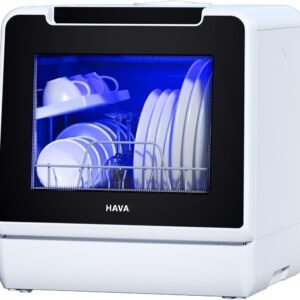
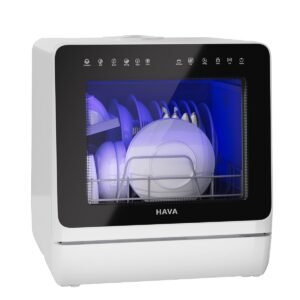
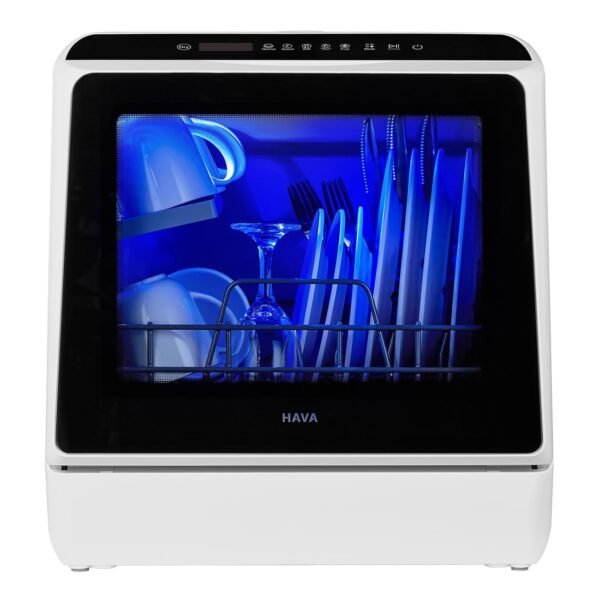
The HAVA TDQR is a countertop dishwasher built around a tank rather than a plumbing connection. HAVA records a countertop form factor, a listed weight of 28.6 pounds, five listed cycle options with six settings, an LED display, 950 watt hours of energy consumption, 5 liters of water consumption, 61 inch inlet and outlet hoses, 60 hertz operating frequency, a polypropylene body, dimensions of 16.8 by 16.9 by 18.1 inches, an annual energy consumption of 150 kilowatt hours per year, a China country of origin and first availability in March 2021.
What it is and where it fits in a home
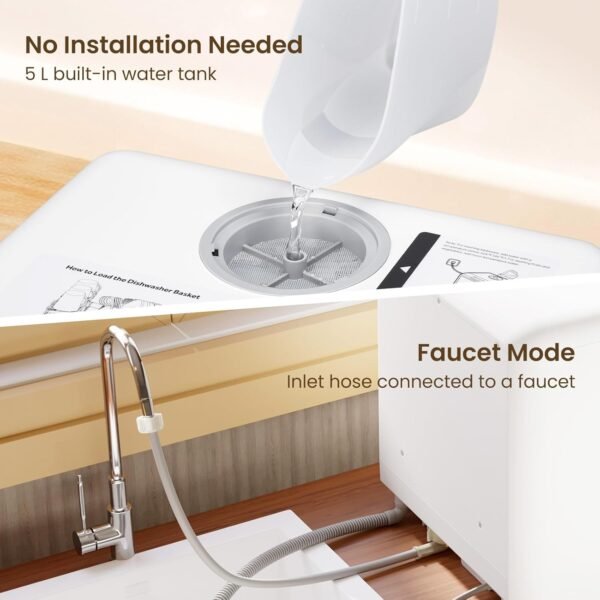
The 5 liter internal tank is the whole point. It means the machine can be set down anywhere there is an outlet and a sink to drain into, with no permanent connection at all. That covers rentals, dorms, RVs, boats, offices and older apartments that were never plumbed for a dishwasher. HAVA also supplies 61 inch inlet and outlet hoses, so it can be connected to a faucet where one is available.
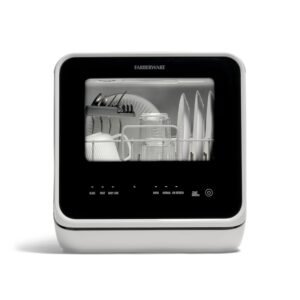
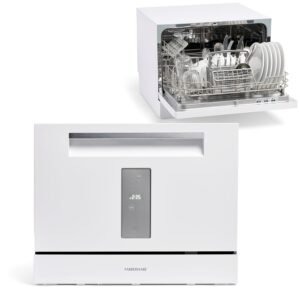
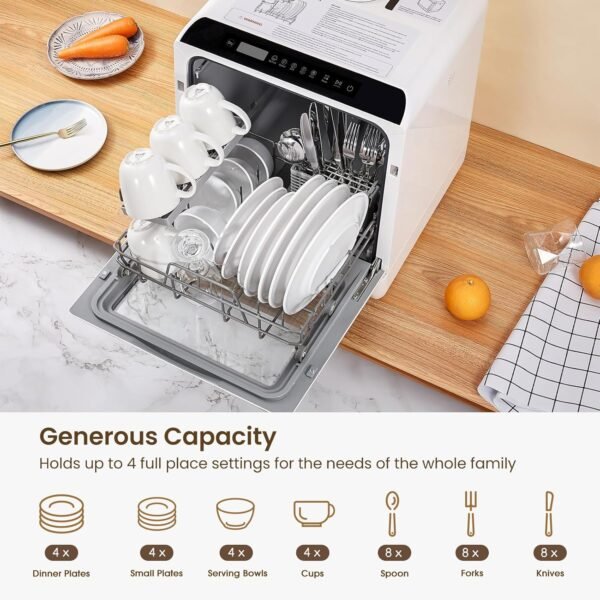
At 16.8 by 16.9 by 18.1 inches it is a compact cube, smaller on the counter than the Farberware FCD06SDWHT at nearly 22 inches wide. At 28.6 pounds it is light enough for one person to move, which matters in a format whose whole appeal is portability. The listing describes capacity as more than 30 pieces of kitchenware, up to four place settings, with angled support for dishes up to 11 inches.
Living with it day to day
Four place settings is the realistic load: plates, bowls, glasses and cutlery for one or two people, run daily. The 11 inch dish support is the useful capacity number, since it is what determines whether a dinner plate fits at an angle. Baking sheets and large pans do not.
The tank changes the daily routine more than any specification does. Five liters has to go in before each cycle, which without a faucet connection means filling by jug. Whether that is acceptable depends entirely on the alternative being washing by hand, and for most people in this format’s target situation it is.
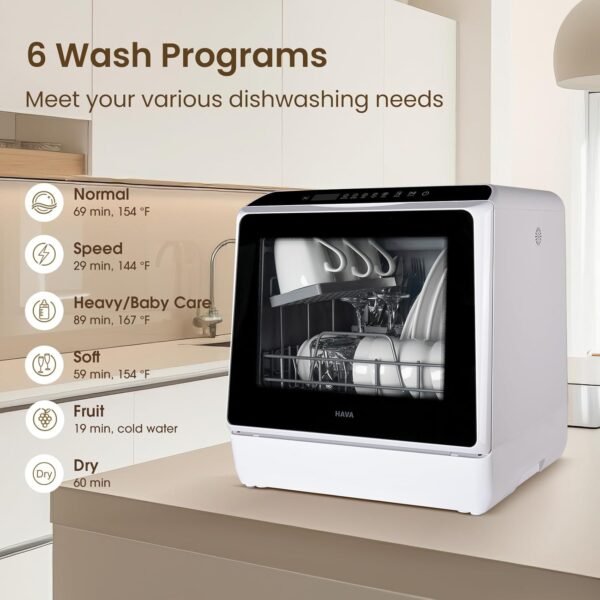
The high temperature program described at 167 degrees Fahrenheit is the useful one for baby bottles, oily dishes and anything that needs sanitizing. HAVA does not publish cycle times for the individual programs, so how long each takes is not something to state.
Two internal inconsistencies in the data are worth naming. The cycle options field lists five programs while the settings count says six, and the same listing elsewhere describes six. Similarly the energy consumption is recorded as 950 watt hours in one field and 150 kilowatt hours per year in another, which are not comparable figures and the listing does not reconcile them. Neither should be repeated as settled.
Noise is not published. A countertop dishwasher sits at ear height with nothing between it and the room, so the absence of a decibel figure matters here more than it would on a built in machine such as the Bosch SHEM63W55N, which publishes 44 decibels.
Controls and what works without an app
Nothing here connects to anything. No Wi-Fi, no app, no phone notifications. An LED display and buttons are the whole interface. For a machine designed to move between homes, that is correct: there is nothing to re register and nothing that stops working if a service is retired.
Programs are selected directly rather than through menus. HAVA describes special features including a quick wash program, the built in water tank and a no installation setup, all of which are physical or program features rather than software ones. The built in dishwashers in the built in dishwasher category carry app connectivity in several cases, and for a machine you stand next to while filling it, that adds very little.
Running cost and upkeep
Detergent is the routine consumable, in a smaller dose than a full sized machine takes. HAVA does not publish the detergent type or quantity for this model. No water softener and no salt reservoir are described on the TDQR, so in a hard water area scale management is manual, which is a difference from the later HAVA TDJR09 that does publish a softener.
The tub filter, the spray arm jets, the tank and the door seal are the parts that need attention. A tank that holds standing water needs draining and drying if the machine is left unused for a while, or it will develop a smell. The polypropylene interior is lighter and cheaper than stainless and it is more prone to staining and holding odors over years.
The electrical data contains a fault to name rather than repeat. The voltage field reads 220 volts on a countertop appliance sold into the North American market, where 120 volts is the standard supply, and the operating frequency is given as 60 hertz, which is the North American figure. A 220 volt entry alongside a 60 hertz entry is internally inconsistent. Do not wire or plan anything from it. The rating plate on the appliance is the only source for the actual supply requirement, and it should be read before the machine is plugged in.
Highlights
- A 5 liter internal tank, so it works with no plumbing connection at all.
- Compact at under 17 inches wide and light enough for one person to move.
- A high temperature program described at 167 degrees Fahrenheit for bottles and oily dishes.
- Water consumption of 5 liters per cycle is published, which many listings omit.
- 61 inch hoses, so faucet connection is possible where a faucet allows it.
Things To Consider
- The voltage field reads 220 volts alongside a 60 hertz frequency, which is internally inconsistent.
- The program count is given as both five and six in different fields.
- Energy use is recorded as 950 watt hours and 150 kilowatt hours per year without reconciling them.
- No noise rating, on a machine that sits at ear height on a counter.
- A polypropylene interior stains and holds odors more than stainless steel does.
Who it is not for
Any kitchen with a dishwasher connection should have a built in machine instead. Among the tank fed options in the countertop category this is a competent pick, but families washing full loads will run it two or three times a day. Anyone washing large bakeware cannot use it at all, given the 11 inch dish limit. And anyone in a hard water area should compare against a machine that publishes a softener rather than choosing this one and descaling by hand.